PALMOILMAGAZINE, JAKARTA – Just 19 months into the presidency of President Prabowo, a massive shift in Indonesia’s structural trajectory is underway. While, the previous governments focused their efforts on policy refinement and the continuous improvement of existing frameworks, the current administration aims directly at altering the country’s core ideology and economic direction.
The ultimate objective is to assert state sovereignty under Article 33 of the Constitution, steering the country toward an “Ekonomi Pancasila” (Pancasila Economy). This strategy involves reining in prominent oligarchs, pressuring them to repatriate wealth and breaking free from an over-dependence on traditional foreign market forces.
This represents a major course correction: a deliberate effort by the state to steer the national economy down a completely new path. However, altering an economic ideology typically takes decades, as evidenced by China gradual opening since 1978.
Also Read: Palm Oil and the Curse of Success
What the Prabowo administration is attempting is to force this massive pivot within a single five-year election cycle. Consequently,, its execution over the past 19 months has been frequently been characterized by rushed, pragmatic manoeuvres.
Article 33 serves as the cornerstone of Indonesia’s economic framework. In his groundbreaking dissertation 1994, a constitutional scholar professor Jimly Asshiddiqie argues that Article 33 establishes a crucial link between political and economic democracy, both of which must remain in balance to protect popular sovereignty. This concept of economic democracy affirms the principles of social solidarity, state control over key production sectors and natural resources and a baseline emphasis on the common good.
That framework was further refined during the 2002 constitutional amendment, which added a fourth paragraph stipulating that economic democracy must be implemented based on “equitable efficiency”. This is defined through the principles of solidarity, efficiency with justice, sustainability, environmental awareness, self-reliance, and a careful balance between national economic unity and progress.
Also Read: Indonesia Targets Higher Palm Oil Productivity and Downstream Growth in 2026
Recently, however, Article 33 has often been treated as a standalone, almost sacred text, its vital fourth paragraph largely overlooked. It is frequently invoked as a broad moral justification to legitimize radical policy shift
While the argument for economic sovereignty is noble, translating the phrase “controlled by the state” into ad-hoc policy decisions can destabilize institutional governance if constitutionalism loses its anchor to the rule of law.
The core challenge lies in the fact that the intellectual foundations of Ekonomi Pancasila have never been monolithic.
Also Read: Prabowo Launches B50 Biodiesel, Declares Indonesia First Nation to Mandate 50% Palm-Based Fuel Blend
Professor Mubyarto, the concept’s most prominent advocate, argued that economic democracy was designed to elevate human welfare, social solidarity and cooperative institutions above both unfettered capitalism and rigid state socialism. In his view, an economy should be judged not merely by gross domestic product growth rates but by its capacity to deliver justice, participation and dignity.
Yet, even during the intense debates of the late 1970s and early 1980s, scholars disagreed on how to operationalize this vision. Professor Arief Budiman famously noted that Ekonomi Pancasila often remained a moral aspiration rather than an functioning economic system.
While it succeeded as a critique of liberal capitalism and the concentration of wealth, it struggled to provide policymakers with a concrete institutional blueprint comparable to the market economies of Western Europe or the developmental states of East Asia.
Also Read: Bahlil: B50 Biodiesel Will Drive Palm Oil Demand and Bolster Energy Independence
That unresolved debate remains highly relevant today. Contemporary calls to revive Article 33 are frequently built on the assumption that Indonesia simply needs a more dominant state presence in the marketplace.
However, neither Mubyarto nor Arief Budiman argued for a simple expansion of bureaucratic power. Their central concern was always how to balance market efficiency, social justice and national development without lapsing into the either laissez-faire capitalism or heavy-handed statism.
This was precisely the nuance that former president B.J. Habibie attempted to introduce in 2017 with the concept of Ekonomi Pasar Pancasila (Pancasila Market Economy). Rather than rejecting markets entirely, Habibie emphasized the need to embed market mechanisms within the ethical framework of Pancasila.
Also Read: KPBN CPO Tender Stays Firm at IDR15,600/kg, No Deals Reached
He argued that economic activity must generate broad-based prosperity rather than facilitate wealth accumulation for a small elite.
While he maintained that prosperity and capital rights were important, he stressed they must ultimately contribute to equitable development and social cohesion, warning against modern forms of global capital domination that could mirror economic colonialism.
What made Habibie’s formulation significant was the explicit inclusion of the word “market”. Unlike older interpretations defined primarily by their opposition to economic liberalism, Ekonomi Pasar Pancasila recognized that market mechanisms were indispensable for innovation, efficiency and economic dynamism.
Also Read: Jambi Raises Palm Fruit Prices to IDR3,856.89/kg for July 10–16
Drawing implicitly from successful Asian models like as Japan and other East Asian developmental economies, Habibie envisioned a system where the state acts as a strategic coordinator rather than the sole economic actor. In this model, market allocates resources efficiently, while the state ensures fairness, long-term planning and broad participation.
This distinction grows increasingly critical as Indonesia enters a period marked by creeping economic nationalism. Economic nationalism is not inherently negative. Many successful Asian economies leveraged nationalist policies to nurture domestic industries, build technological capabilities and strengthen strategic sectors. The problem emerges when nationalism evolves into discretionary state intervention detached from institutions checks, legal certainty and market discipline.
Signs of this regulatory shift are becoming visible in Indonesia. Under the banner of sovereignty, self-sufficiency and the national interest, all justified under the umbrella of article 33, state intervention has expanded into areas once governed by relatively predictable rules. Abrupt permit revocations, asset seizures, pressure on private businesses to align with state priorities and highly interventionist regulatory approaches have sent mixed signals to investors and broader businesses community.
Also Read: Agrinas Palma Nusantara Reports Strong 2025 Performance with IDR2.86 Trillion Operating Surplus
History provides ample warnings. Indonesia’s own experience with “ekonomi terpimpin” (guided economy) under Soekarno demonstrated how an excessive concentration of economic decision-making can ultimately undermine productivity and choke off investment.
Internationally, nations that pursued aggressive economic nationalism without robust institutional guardrails have consistently encountered declining competitiveness, capital flight and stagnation.
Sovereignty, after all, is not strengthened merely by expanding the apparatus of state power. As the 1945 Constitution defines it, true economic democracy occurs when citizens, small and medium enterprises and both domestic and foreign businesses work in tandem with the state to advance our common welfare through equitable efficiency. (*)
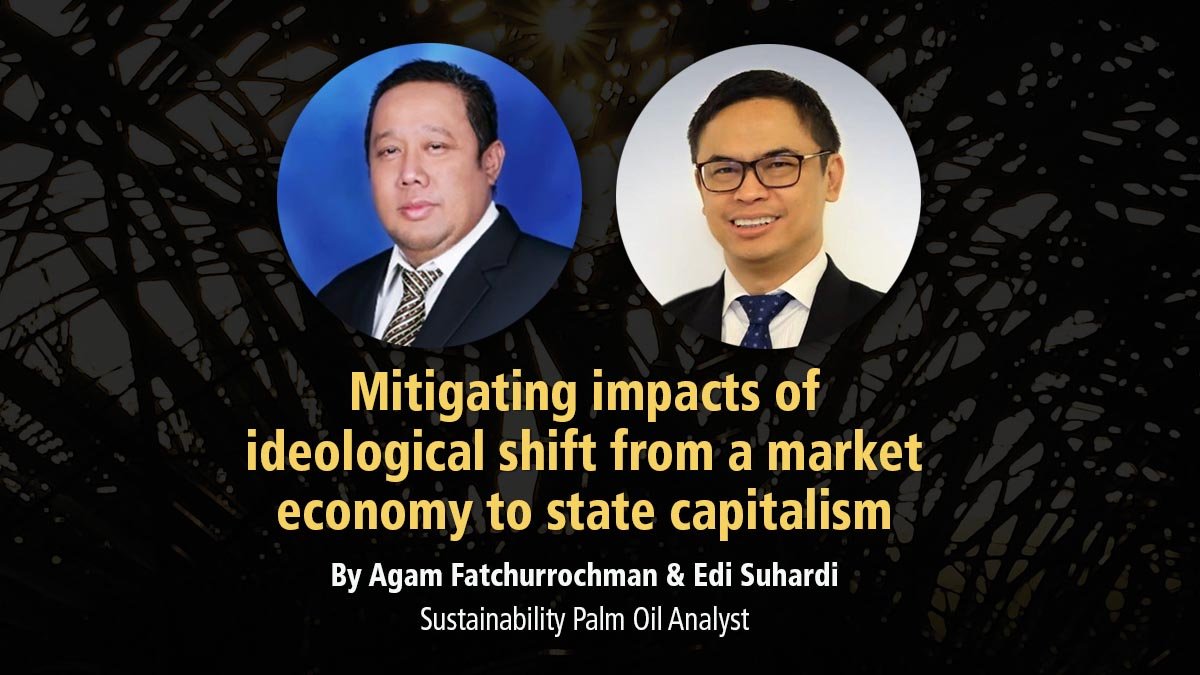
By Agam Fatchurrochman & Edi Suhardi / Jakarta
Sustainability Analysts