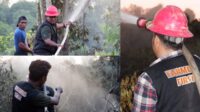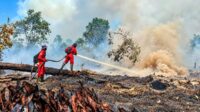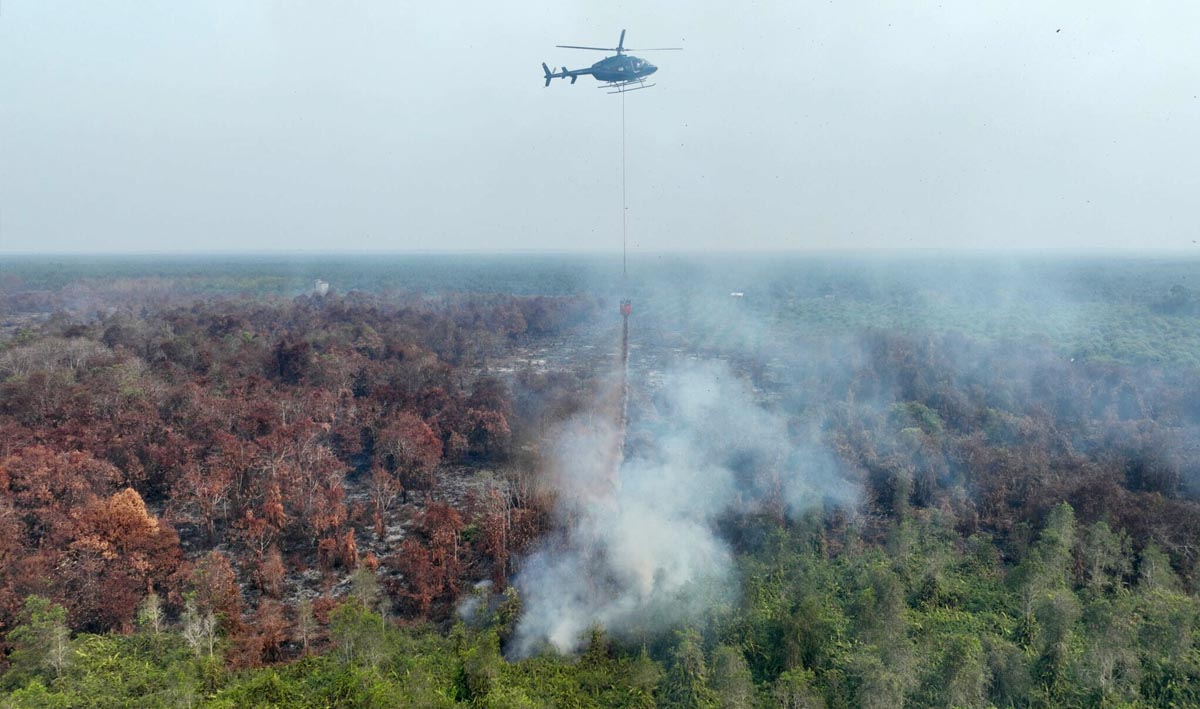
Musim Mas has deployed more than 1,000 personnel, 16 firefighting vehicles and a water-bombing helicopter while supporting fire response in 13 villages and providing free health services to communities affected by wildfire smoke.
PALMOILMAGAZINE, MEDAN, INDONESIA — Musim Mas Group has stepped up its response to forest and land fires in Central Kalimantan, deploying more than 1,000 personnel, 16 firefighting vehicles and a helicopter equipped for aerial water bombing as dry conditions heighten wildfire risks across the region.
Since July 8, 2026, the company has mobilized firefighting teams not only across its operational areas but also in surrounding communities. The company’s firefighting teams have assisted with fire response in 13 villages: Sebabi, Kenyala, Tanah Putih, Hanjalipan, Tangar, Baampah, Penyang, Camba, Soren, Bagendang Tengah, Natai Baru, Palangan and Kandan.
Also Read: Musim Mas Wins Mahayuga Award 2026 as Green Industry Pioneer
The response comes as Indonesia continues to face challenging weather conditions. The Meteorology, Climatology and Geophysical Agency (BMKG) has reported relatively dry atmospheric conditions in several parts of the country, including Kalimantan, while a very strong El Niño event is expected to persist into early 2027.
Musim Mas said it is maintaining a high level of preparedness through rapid response, field monitoring and preventive measures aimed at reducing the risk of forest and land fires, locally known as karhutla (kebakaran hutan dan lahan).
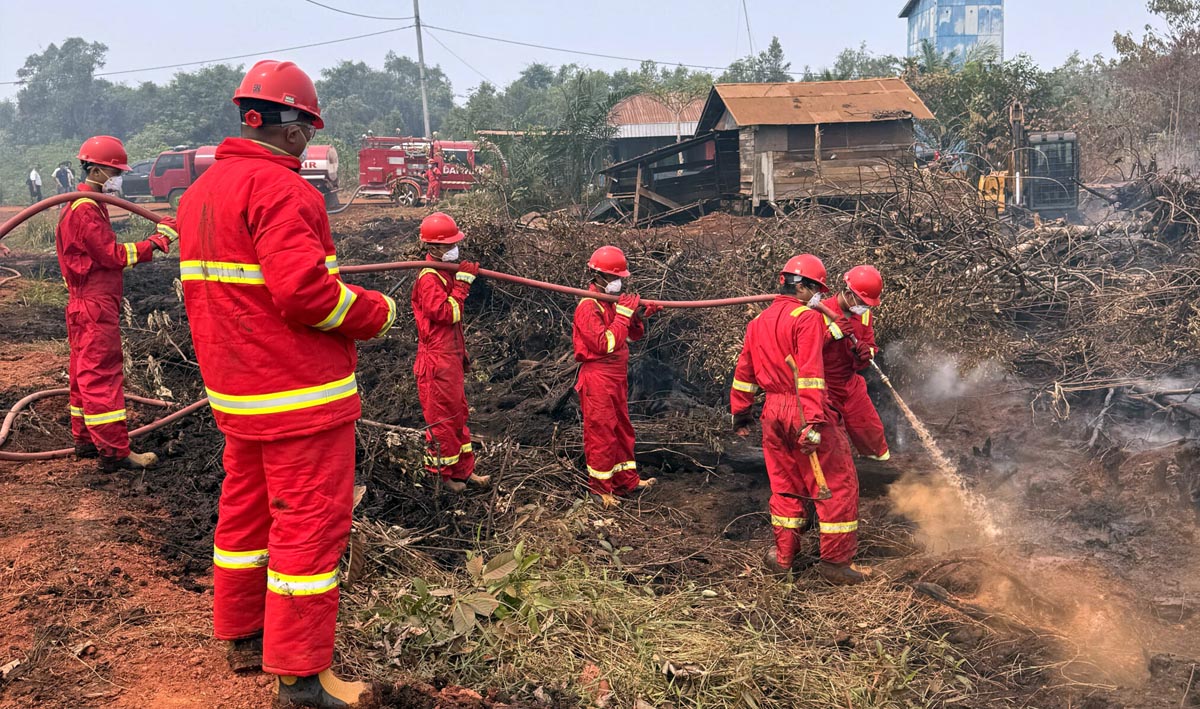
Ground and Aerial Firefighting
Bangun Hapsoro, survey manager at Musim Mas Group and the company’s Central Kalimantan karhutla response coordinator, said the company combines several firefighting methods to contain fires as quickly as possible.
“We cannot rely on a single method in the field. Some teams operate from the ground, while water bombing is used to reach difficult locations. Heavy equipment is also deployed to create firebreaks and prevent fires from spreading,” said Bangun, in a statement received by PalmOilMagazine on Monday (Oct. 5).
Also Read: Musim Mas and IPB University Launch Sustainable Campus Hub Through Revitalized Kantin Rimbawan
The company operates one helicopter equipped with a Bambi Bucket capable of carrying about 800 liters of water per drop. Under certain conditions, the helicopter can conduct up to about 30 water-bombing operations a day.
Bangun said aerial water bombing is primarily used as an initial response to reach fire locations that are difficult for ground crews to access and to slow the spread of flames. Ground teams then continue with spraying and cooling operations until the fire and remaining hot spots have been brought under control.
Firefighting becomes particularly challenging in peatland areas, where flames can continue below the surface even after visible fires have been extinguished.
“In peatlands, the work does not end when the fire is no longer visible. We continue cooling the area and making sure there are no remaining embers,” Bangun said.
Access to water is another major challenge. Several water sources, including reservoirs and rivers, have declined significantly or dried up amid prolonged dry conditions.
“The main challenge in firefighting is having water sources that are far away. But we cannot deal with challenges like this alone. That is why we continue coordinating with local governments and communities so available resources can be shared,” Bangun said.
Also Read: GAPKI Strengthens Forest and Land Fire Prevention, Expands Monitoring Around Palm Oil Concessions
More Than 1,000 Employees Join Firefighting Efforts
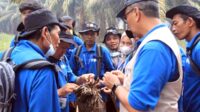
The scale of the response has made manpower a critical component of Musim Mas’ fire-management operations. More than 1,000 staff and employees in Central Kalimantan have been assigned to firefighting teams, working in shifts for more than two months.
Suparman, assistant head of the Musim Mas Group Training Center, is among those involved in the firefighting effort. He said participating in fire response reflects the company’s responsibility toward the environment and communities around its operations.
“It is tiring. For more than two months, we have remained on standby and worked in shifts. But our goal is simple: to put the fires out quickly, improve air quality and allow communities to return to their normal activities comfortably,” Suparman said.
Working through dense smoke presents additional risks for firefighting crews. Musim Mas said it provides teams with protective equipment and health support, including supplements and vitamins.
Free Health Posts Support Smoke-Affected Communities
Musim Mas’ response extends beyond firefighting, with the company also addressing potential health impacts from wildfire smoke.
The company has established five free health posts in several locations in East Kotawaringin, in cooperation with the local Health Agency and community health centers.
Also Read: Indonesia Agrarian Reform Law Raises Land Risk for Malaysian Palm Oil Companies
The facilities are intended to bring medical services closer to residents, particularly those requiring medical attention amid deteriorating air quality.
Dr. Yulin Effendi, a company physician and coordinator of the health posts, said each facility treats approximately 100–120 patients. About 30–40% of patients have reported respiratory complaints, including coughing and shortness of breath.
“Services include health examinations, medicines, vitamins, masks and oxygen for people who need it,” Yulin said.
Also Read: 84% of Indonesia’s September Fire Hotspots Found in Open-Access Areas, Expert Says
Fire Response Requires Multi-Stakeholder Cooperation
Firefighting efforts are also being carried out in coordination with local authorities and the East Kotawaringin Regional Disaster Management Agency (BPBD).
Rihel Magat, acting head of the East Kotawaringin BPBD, said effective fire management requires cooperation among multiple stakeholders.
Also Read: Desacralizing Local Wisdom to Mitigate Forest and Land Fires
“Forest and land fire response requires a working group. It cannot involve only the local government, but also communities, sub-district authorities and the private sector,” Rihel said.
He added that private-sector support can strengthen local government firefighting capacity, particularly when firefighting equipment and vehicles are limited.
Musim Mas has also provided additional equipment to support the local response, including a water tank and a water cannon.
Also Read: RSPO Calls for Coordinated Response to Indonesia Fires to Protect Communities and Wildlife
Beyond direct firefighting assistance, the company has distributed firefighting equipment to 14 villages in East Kotawaringin, including water pumps, hoses, nozzles and other supporting equipment.
The assistance is intended to strengthen community preparedness and enable residents to respond more quickly during the early stages of a fire.
Prevention Remains a Key Focus
Musim Mas said its strategy extends beyond responding to fires after they occur. The company has implemented a Zero Burning Policy, prohibiting the use of fire for land-management activities.
The policy is supported by early-warning systems, patrols, firefighting teams and regular personnel training.
Also Read: East Kalimantan Sets FFB Price at IDR 3,617.55/kg for Sept. 16–30
The early-warning system begins with the identification of potential hot spots through satellite imagery. Each hot-spot alert is subsequently verified by field teams. Drones are deployed to assess locations that are difficult to reach, while fire-watch towers provide additional monitoring.
Musim Mas also maintains trained firefighting teams equipped with vehicles and firefighting equipment and has developed water reservoirs to provide additional sources of water during emergencies.
The company’s prevention efforts also extend beyond its operational areas through its Masyarakat Bebas Api (MBA) program, which has been implemented since 2016.
Also Read: Pekanbaru Develops Sustainable Palm Oil Action Plan for 24,000 Hectares of Plantation Area
The program encourages communities to participate in fire prevention through education, capacity building, monitoring and patrols, as well as access to firefighting equipment. One of its key objectives is to promote land-clearing practices without fire while improving communities’ ability to identify potential fire risks and undertake early response.
Musim Mas also provides recognition to villages that remain fire-free for an entire year.
The company said the approach is designed to ensure fire prevention begins before an incident occurs by building preparedness and shared responsibility among companies, authorities and communities.
For Musim Mas, tackling karhutla is not simply about how quickly a fire can be extinguished. During an extended dry season, the challenge also involves keeping response teams ready, supporting communities when assistance is needed and maintaining preventive measures to reduce fire risks across the landscape. (P3)