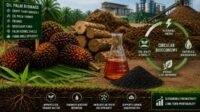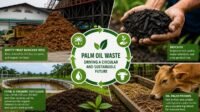
Researchers have converted lignin from oil palm empty fruit bunches into nanoscale particles and tested its ability to capture lead ions. The findings highlight a potential circular-economy pathway for turning palm oil waste into value-added environmental materials.
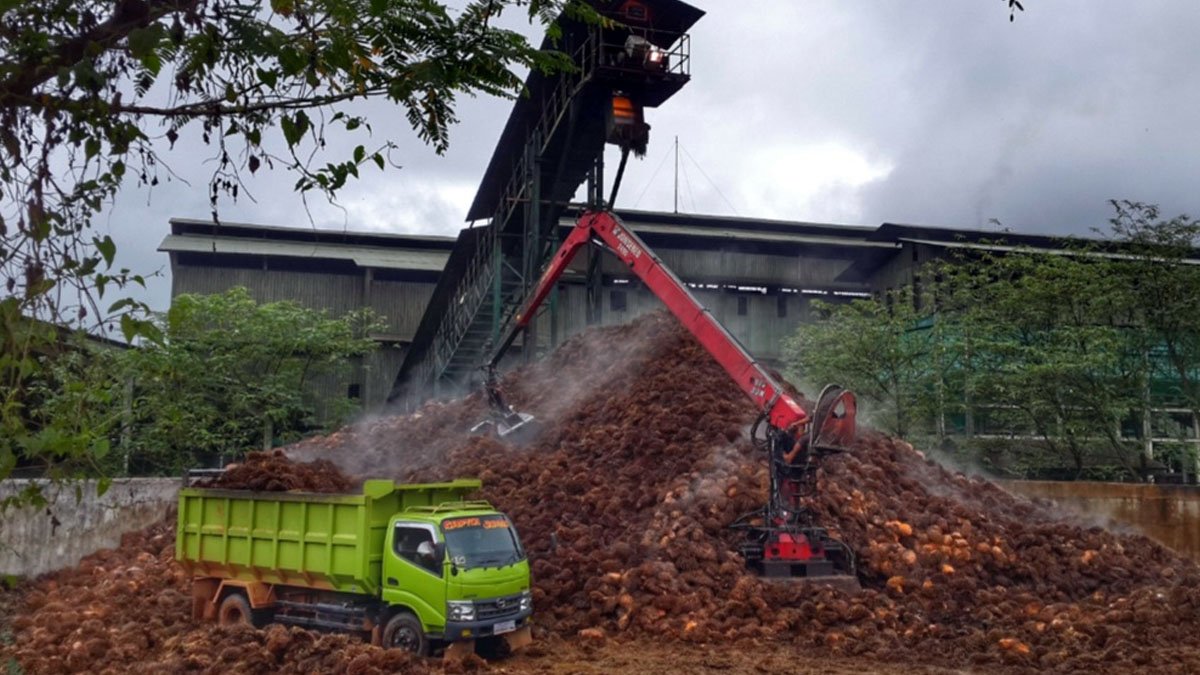
PALMOILMAGAZINE, JAKARTA — Empty fruit bunches (EFB), a major by-product of palm oil processing, could be developed into a value-added biomaterial for environmental applications. Research has shown that lignin extracted from EFB has potential as an adsorbent for removing heavy-metal contamination from water.
According to research by Mirza Ardella Saputra, Ph.D., of Airlangga University, the potential of EFB lignin was explored by reducing the material to nano- and submicron-sized particles. The process combined ball milling, solvent shifting and ultrasonication to modify the particle size and characteristics of lignin.
Also Read: BPDP-Funded Palm Oil Research Must Deliver Practical Solutions for Smallholders
Characterization results showed that ultrasonication reduced the lignin particle size to approximately 268 nanometers, indicating the formation of nanolignin with characteristics suitable for use as an adsorbent material.
The nanolignin was subsequently chemically modified through a Mannich reaction to improve its functional properties. Triethylamine was used as a tertiary amine source. The modification was confirmed through CHN elemental analysis and Fourier Transform Infrared (FTIR) spectroscopy, which detected the addition of nitrogen-containing functional groups to the lignin structure.
The researchers then tested the material’s ability to adsorb lead ions (Pb²⁺) using a batch method. The remaining metal-ion concentration was measured using Inductively Coupled Plasma Optical Emission Spectrometry (ICP-OES) for both unmodified and aminated lignin.
Also Read: UB Chemical Engineering Students Win CHEVERSE 2026 with Palm Waste Bioethanol Innovation
The results showed clear differences in adsorption performance. Nanolignin produced through the solvent-shifting process delivered the highest adsorption performance, achieving a Pb²⁺ removal efficiency of 83.9%.
By comparison, nanolignin modified with tertiary amine groups recorded a Pb²⁺ removal efficiency of 74.2%. The finding indicates that adding nitrogen-containing groups does not necessarily improve a material’s ability to adsorb lead ions.
Also Read: UNAIR Graduate Wins Global Award for Turning Palm Waste into Jet Fuel
Energy Barriers Affect Adsorption Performance
To better understand the results, the researchers used computational modeling based on Density Functional Theory (DFT) combined with the Nudged Elastic Band (NEB) method.
The simulations examined how Pb²⁺ interacts with the lignin structure and identified potential energy barriers during the adsorption process.
The calculations indicated that Pb²⁺ adsorption on unmodified lignin can occur spontaneously without an activation-energy barrier and is exothermic. The adsorption energy was approximately -0.33 eV, with the primary interaction occurring between Pb²⁺ and phenolic hydroxyl groups in the lignin structure.
Also Read: From Waste to Wealth: Can Oil Palm Biomass Become Indonesia’s Next Green Growth Engine?
A different behavior was observed in nitrogen-modified lignin. Although the material recorded a more favorable final adsorption energy of approximately -1.3 eV, the transition state involved a moderate activation barrier of around 1.5 eV.
The simulations also showed that Pb²⁺ changes position during adsorption. The ion initially sits above an aromatic ring containing the nitrogen dopant before moving toward a phenolic oxygen atom, ultimately forming a stronger Pb–O bond.
These findings suggest that the final strength of interaction between Pb²⁺ and lignin is not the only factor determining adsorption performance. Energy barriers and the characteristics of functional groups on the material’s surface also influence its ability to capture heavy-metal ions.
Also Read: EU Exempts Palm Oil Waste from EUDR, Creating New Opportunities for Circular Economy Growth
Turning Palm Oil Waste Into Value-Added Materials
The research provides insight into the limitations of using bulky tertiary amine groups to improve Pb²⁺ adsorption in lignin-based materials. Chemical modification does not automatically translate into better performance if the added functional groups restrict access of metal ions to active sites on the material.
For the palm oil industry, the use of EFB-derived lignin as an adsorbent could create opportunities to transform plantation and processing waste into higher-value biomaterials.
Also Read: BRIN Advances Pyrolysis Technology to Turn Oil Palm Empty Fruit Bunch Waste into Renewable Energy
The approach also supports the development of a circular economy in the palm oil sector, shifting EFB from a largely underutilized residue toward a potential feedstock for environmental applications such as heavy-metal removal from contaminated water. (P2)