PALMOILMAGAZINE, JAKARTA — Crude palm oil (CPO) futures on Bursa Malaysia Derivatives (BMD) closed lower on Thursday (April 23, 2026), snapping a three-day streak of gains as traders locked in profits amid weakening olein prices in the Chinese market.
At the close, the May 2026 CPO contract fell by MYR44 to MYR4,505 per ton, while the June 2026 contract declined by MYR47 to MYR4,552 per ton.
Losses extended into later contracts. The July 2026 contract dropped MYR49 to MYR4,579 per ton, followed by August 2026, which slipped MYR47 to MYR4,593 per ton.
Also Read: Indonesia Accelerates Palm Oil Downstreaming While Planning Major Plantation Expansion
Meanwhile, the September 2026 contract fell MYR41 to MYR4,598 per ton, and October 2026 eased MYR38 to MYR4,690 per ton.
According to TradingView, Anilkumar Bagani, Head of Commodity Research at Sunvin Group, noted that the decline in CPO prices is in line with trends in the global vegetable oil market.
“Futures moved lower due to profit-taking, tracking weaker palm olein prices in Dalian and softer soybean oil in Chicago,” he noted.
Also Read: Apical Strengthens SME Capacity in North Jakarta Through Practical Culinary Training
In other markets, the most active soybean oil contract in Dalian edged up 0.09%, while its palm oil contract slipped 0.05%. Meanwhile, soybean oil prices on the Chicago Board of Trade declined by around 0.2%.
CPO prices typically track movements in other vegetable oils, as they compete within the same global market. Fluctuations in soybean oil and related commodities often serve as key price drivers.
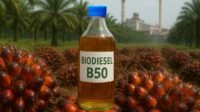
On the policy front, Indonesia’s energy strategy continues to offer underlying support. The government plans to raise its palm-based biodiesel blending mandate from 40% (B40) to 50% (B50) starting July 1, 2026. The move is expected to boost domestic CPO consumption and strengthen energy security.
Also Read: Central Kalimantan FFB Prices Increase to IDR 3,897/kg in Early April Period
Meanwhile, global crude oil prices remain on an upward trend, supported by geopolitical tensions and stalled negotiations between United States and Iran, as well as ongoing trade restrictions in the Strait of Hormuz.
Higher crude oil prices tend to enhance the attractiveness of CPO as a biodiesel feedstock. However, a 0.3% depreciation of the Malaysian ringgit against the US dollar has made Malaysian palm oil more competitive for export, though it was insufficient to offset the downward pressure in the latest trading session. (P3)