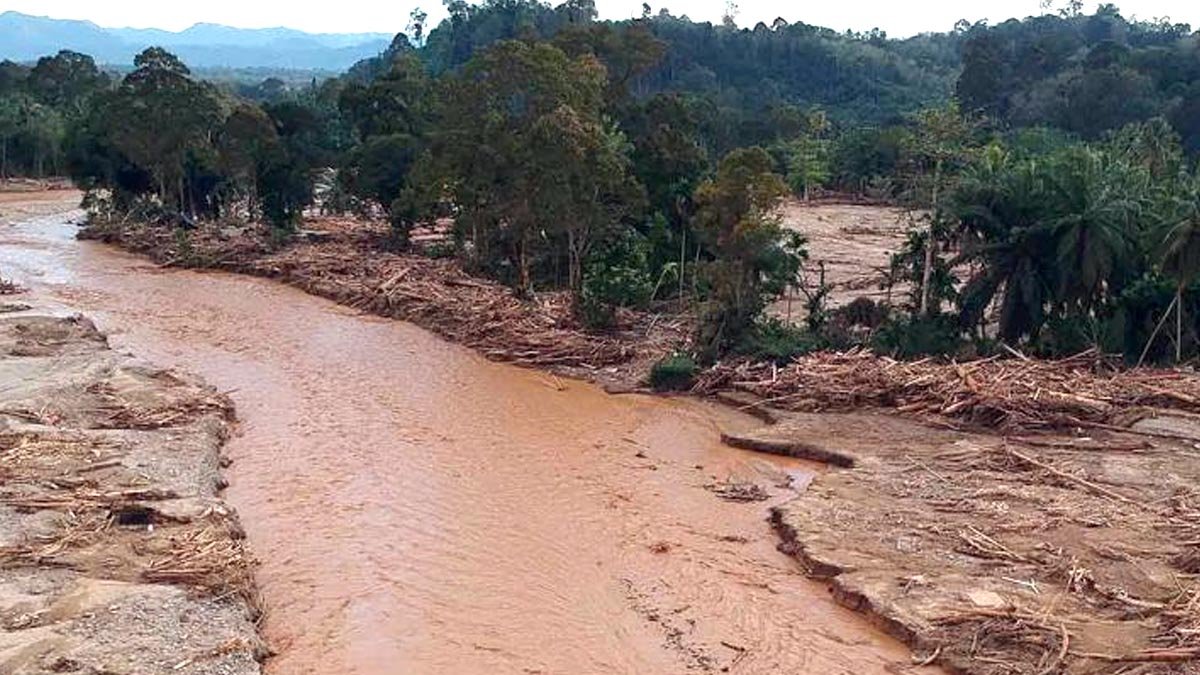
PALMOILMAGAZINE, SOUTH TAPANULI — The government has moved swiftly in response to the massive floods and landslides that struck South Tapanuli Regency, North Sumatra. The Ministry of Environment/Environmental Control Agency (KLH/BPLH) has deployed a full investigation team to trace the root causes of the disaster, focusing on the upstream areas of the Batang Toru and Garoga river basins—two of the most vulnerable zones.
From early morning, Minister of Environment and Head of BPLH, Hanif Faisol Nurofiq, conducted an aerial inspection by helicopter, followed by ground verification. The inspection aimed to identify ecological pressures that may have worsened the disaster and to assess the compliance of companies operating in the upstream area with environmental protection standards.
During the visit, Minister Hanif inspected three major companies operating in the highlands: PT Agincourt Resources, PTPN III, and PT North Sumatra Hydro Energy (NSHE), the developer of the Batang Toru hydropower project. Based on initial findings in the field, the government issued a firm decision: all three companies must temporarily halt operations and undergo a comprehensive environmental audit.
“Effective 6 December 2025, every company operating in the upstream Batang Toru watershed is required to suspend operations and begin an environmental audit. We have also summoned the three companies for a formal examination on 8 December 2025 in Jakarta. The Batang Toru and Garoga watersheds are strategic areas whose ecological and social functions cannot be compromised,” Minister Hanif stated, as quoted by Palmoilmagazine.com from the ministry’s official release, Monday (8/12/2025).
The decision was not made without evidence. During the aerial monitoring, the KLH/BPLH team detected significant shifts in land cover. Rizal Irawan, Deputy for Environmental Law Enforcement, explained that the helicopter survey revealed clear indications of large-scale land clearing.
“From the aerial overview, we observed land clearing for the hydropower project, industrial timber plantations, mining, and oil palm estates. The cumulative pressure has contributed to massive wood debris flow and severe erosion. We will expand our monitoring to Batang Toru, Garoga, and other watersheds across North Sumatra,” Rizal said.
Extreme rainfall—reaching up to 300 millimeters per day—has increased the vulnerability of the upstream landscape. Minister Hanif noted that the situation requires a full evaluation of every business activity operating on steep slopes and river corridors.
“Environmental recovery must be viewed from a landscape-wide perspective. We will assess the damage, review all legal aspects, and we do not rule out criminal proceedings if we find violations that worsened the disaster,” he said.
To strengthen prevention efforts, KLH/BPLH has tightened verification of environmental approvals and spatial planning compliance for all companies operating in disaster-prone areas. Law enforcement measures will be taken if evidence of violations that increase flood or landslide risks is found.
“We will not hesitate to take firm action against any violation. Environmental law enforcement is a key instrument to protect communities from disasters that are, in many cases, preventable,” Minister Hanif concluded. (P2)