
Indonesia is accelerating downstream development across seven strategic plantation commodities, backed by 870,000 hectares of plantation expansion, replanting and rehabilitation, alongside investments in processing industries to reduce reliance on raw commodity exports.
PALMOILMAGAZINE, JAKARTA — Indonesia is stepping up efforts to transform its plantation sector through downstream industrial development, productivity improvements and expanded processing capacity, with the government targeting more than 90% of plantation commodity exports to consist of processed and value-added products.
Deputy Minister of Agriculture Alim Setiawan Slamet said the target forms part of a broader strategy to increase domestic value creation, strengthen industrial competitiveness and deliver greater economic benefits to plantation farmers.
Also Read: Indonesia’s DSI Says Single Export Gateway Will Strengthen Palm Oil Trade Ahead of 2027 Launch
He emphasized that plantations play a strategic role in supporting food and energy self-sufficiency while advancing Indonesia’s industrialization agenda under President Prabowo Subianto’s Asta Cita development priorities. Palm oil, cocoa and coconut, in particular, offer significant opportunities for further processing into higher-value products.
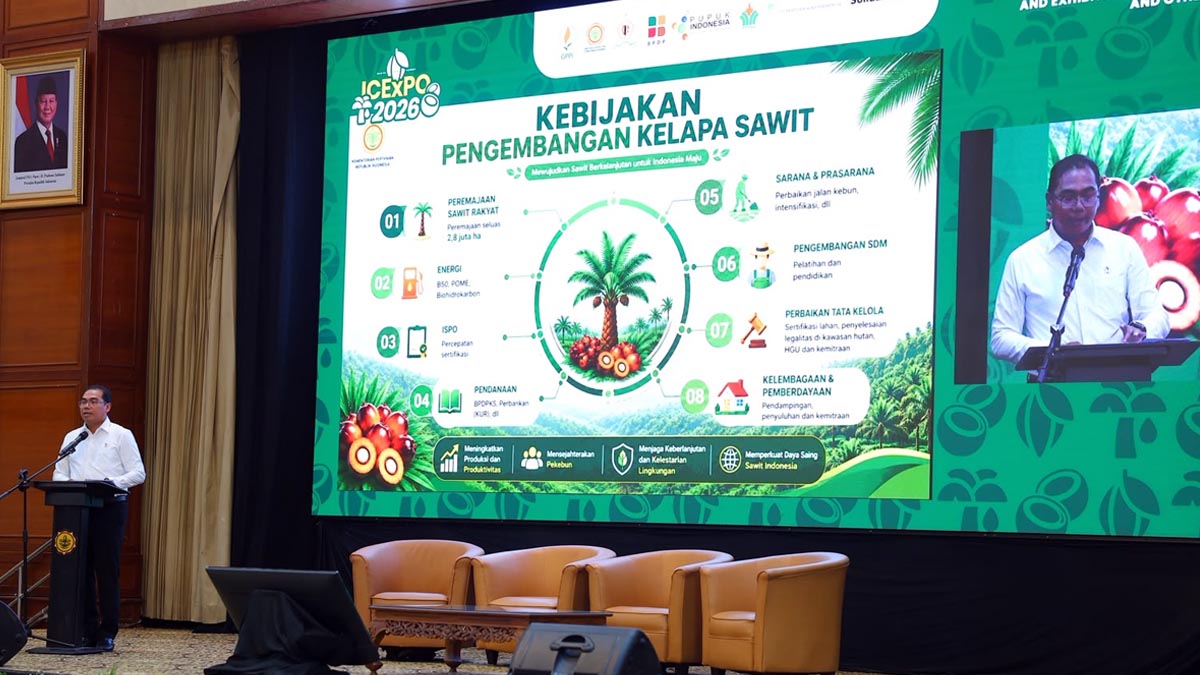
“Plantations are not merely a source of foreign exchange. They also support the economy, create jobs, improve people’s welfare and provide a foundation for our future renewable energy development,” Alim said during the International Conference and Expo on Palm Oil and Others (ICExPO) 2026 at the Ministry of Agriculture’s headquarters in Jakarta on Wednesday (Nov. 4, 2026).
Since 2025, the government has been implementing a downstream development programme covering seven priority plantation commodities: sugarcane, coconut, coffee, cocoa, cashew, pepper and nutmeg.
Also Read: RSPO, CPOPC and Kadin Strengthen Sustainable Palm Oil Collaboration
The initiative is designed to reshape Indonesia’s plantation industry by shifting away from dependence on raw commodity exports towards a more diversified portfolio of processed products with higher economic value.
Alim said approximately 20–30% of Indonesia’s plantation commodity exports are currently shipped in raw form. The government aims to reverse this structure, targeting more than 90% of exports in the future to consist of downstream products.
“Our target is to ensure that more than 90% of plantation exports are in the form of derivative products,” he said, as quoted by PalmOilMagazine from the Ministry of Agriculture’s website on Friday (Nov. 6).
Also Read: Indonesia Cuts November 2026 CPO Reference Price 6.07% to US$978.90/MT, Sets Export Duty at US$124
870,000 Hectares Targeted for Plantation Development
At the upstream level, the downstream programme includes plantation expansion, replanting and rehabilitation covering approximately 870,000 hectares. Implementation involves land preparation, the provision of high-quality planting materials and the adoption of good agricultural practices.
In 2026, the government is developing 174,000 hectares of cocoa plantations and 151,554 hectares of coconut plantations.
Also Read: Malaysia CPO Prices Plunge RM174 as Soybean Oil Weakness Hits Futures, KPBN Tender Withdraws
Alim highlighted the substantial value-adding potential of coconut processing. Fresh coconuts, which sell for approximately IDR1,350 per kilogram, can be processed into coconut oil valued at around IDR60,000 per litre. Further processing into virgin coconut oil (VCO) can increase the value to approximately IDR145,000 per litre.
“This is not merely a calculation on paper. In October last year, downstream coconut products from North Maluku were already exported to China,” he said.
Beyond coconut and cocoa, the government is also strengthening sugarcane development as part of its efforts to achieve self-sufficiency in domestic consumption sugar.
Also Read: Riau FFB Prices Fall to IDR 3,762.61/kg for November 4–10, 2026
Indonesia’s dependence on imported sugar, which Alim said costs approximately IDR44 trillion annually, has prompted the government to expand sugarcane cultivation and implement a ratoon replacement programme, known as bongkar ratoon, beginning in 2025.
Palm Oil Positioned as a Strategic Renewable Energy Feedstock
The Deputy Minister also underscored the plantation sector’s growing importance in strengthening national energy security.
Against a backdrop of geopolitical uncertainty and disruptions to global energy supplies, Indonesia is seeking to expand the use of plantation commodities as feedstock for renewable energy production.
One of the government’s key initiatives is the implementation of the B50 biodiesel mandate, marking another step towards national energy self-sufficiency.
Also Read: RSPO Upholds Accountability while Addressing Indonesia’s Fire Crisis at RT2026
The government is also preparing for the gradual introduction of an E10 bioethanol programme, using feedstocks such as sugarcane, cassava, corn, sorghum and cashew.
To support these ambitions, Indonesia is preparing to develop between 2 million and 5 million hectares of oil palm plantations for bioenergy purposes.
Additional feedstock development for bioethanol will focus on sugarcane, corn and cassava. These programmes are intended to integrate upstream agricultural production with downstream processing industries while utilizing available land in accordance with applicable regulations.
Also Read: Indonesia Cuts November 2026 CPO Reference Price 6.07% to US$978.90/MT, Sets Export Duty at US$124
Research and Technology Key to Improving Competitiveness
Alim said the transformation of Indonesia’s plantation industry would require sustained support from research, technological development and innovation.
Priorities include high-yielding varieties, precision agriculture, mechanization, artificial intelligence applications and the development of higher-value downstream products.
Also Read: Indonesia’s DSI Says Single Export Gateway Will Strengthen Palm Oil Trade Ahead of 2027 Launch
Coconut, for example, can be processed into a wide range of products, including VCO, coconut milk, coconut water, coco fiber, coco peat, activated charcoal and animal feed.
Maximizing the use of different parts of plantation commodities can increase economic returns while creating opportunities for more efficient, resource-conscious and low-waste industrial operations.
“Technology and innovation must transform the comparative advantages we possess into competitive advantages,” Alim said.
ICExPO 2026 Seeks Stronger Industry Collaboration
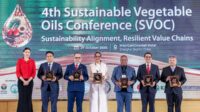
Through ICExPO 2026, now entering its ninth year, Alim expressed hope that the event would provide a platform for collaboration and generate practical solutions, technologies and innovations to address the needs of oil palm, cocoa and coconut farmers.
He stressed that achieving the government’s downstream ambitions would require clearly defined responsibilities among stakeholders.
The government is expected to provide regulatory support, incentives and infrastructure, while the private sector is encouraged to increase investment in processing facilities and strengthen its capacity to absorb plantation output.
Farmers and cooperatives, meanwhile, need to maintain product quality and ensure consistent supply. Access to financing, research, innovation and technical assistance will also be essential to building a competitive and sustainable plantation industry.
“We hope ICExPO 2026 will serve as a discussion platform that generates practical breakthroughs, not only for palm oil but also for coconut and cocoa,” Alim concluded. (P3)