PALMOILMAGAZINE, JAKARTA – Rumah Sawit Indonesia (RSI) has emphasized that accelerating the Smallholder Palm Oil Replanting Program (PSR) must go hand in hand with stronger farmer institutions, simplified governance, and strategic partnerships to ensure the successful transformation of Indonesia’s smallholder palm oil sector into a more industrialized and competitive era.
Representing RSI Chairman Kacuk Sumarto, Sabri Basyah, board member and one of the organization’s founders, said long-standing barriers faced by palm oil farmers are systemic and continue to recur. These include weak farmer organizations, complex land legality issues, and lengthy administrative procedures surrounding the PSR program.
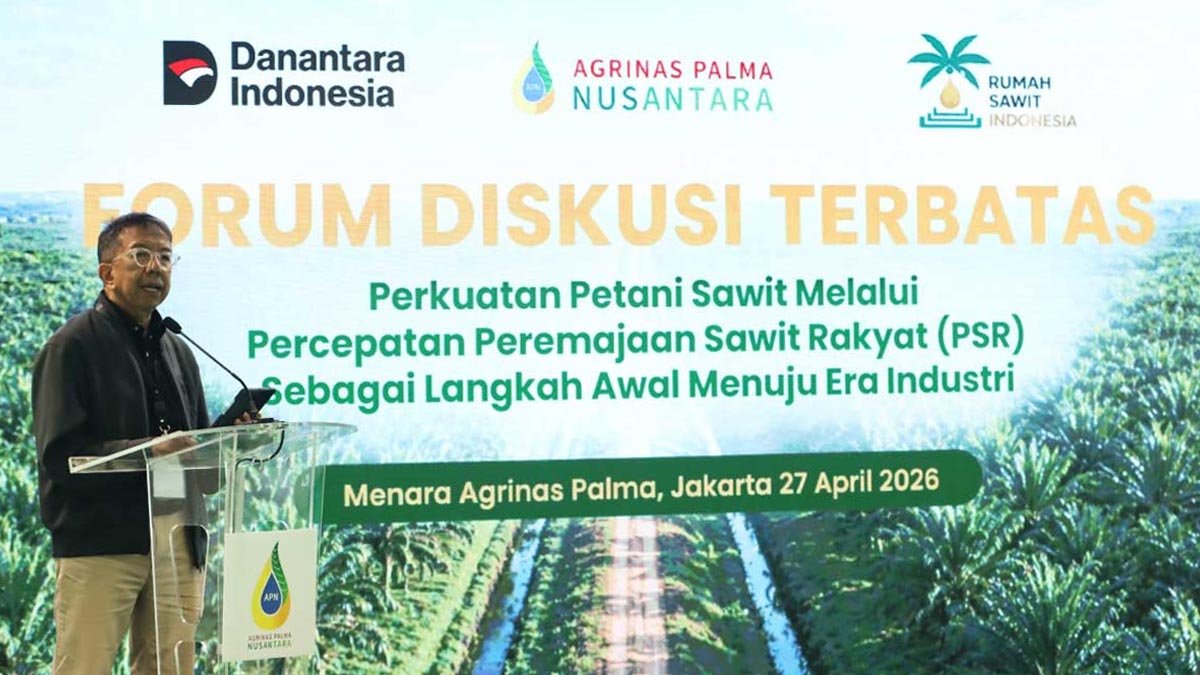
Speaking at a closed-door forum titled Penguatan Petani Sawit melalui PSR Menuju Awal Era Industrialisasi at Menara Agrinas Palma in Jakarta on Monday (April 27, 2026), Sabri noted that many farmers still struggle to access financing and replanting support because institutional capacity remains limited.
Also Read: From Plantations to Energy: Downstreaming Becomes Key to National Self-Reliance
He added that complicated land documentation, including private land titles, forest area status, and plantation registration certificates (STDB), often takes years to resolve, slowing progress on replanting efforts.
Technical challenges such as land mapping, polygon preparation, multilayered bureaucracy from central to regional authorities, and underdeveloped partnership schemes also remain major obstacles that require new solutions.
According to Sabri, Indonesia must adopt a more corporate-style approach to PSR implementation, covering mapping, planning, and project management with greater precision and measurable targets.
Also Read: Strengthening Incentives Key to Advancing Smallholder Palm Oil Traceability in Indonesia
He also stressed the need to strengthen partnerships among nucleus estates, plasma schemes, and independent smallholders so that PSR execution can move faster and more effectively.
“We can no longer rely on conventional approaches. We need measurable and impactful strategies so PSR targets can be achieved through a more modern system,” he said.
During the forum, participants also signed a cooperation commitment covering project feasibility studies, stronger implementation management, farmer mentoring toward industrialization, and policy research support to accelerate program execution.
Sabri said the initiative should not be viewed merely as an annual government program, but as part of building a sustainable long-term system for Indonesia’s smallholder palm oil sector.
He also highlighted the importance of promoting an objective, data-based narrative about palm oil’s contribution to the national economy, including job creation and regional development.
“We need to communicate the facts that palm oil makes a major contribution to the economy, creates employment, and drives regional growth. That narrative must be built strongly and objectively,” he said.
Also Read: KPBN CPO Price Falls to IDR 15,459/kg as Global Palm Oil Market Softens
Sabri further warned that delays in accelerating PSR would result in lost production potential, slower productivity gains, and delayed improvements in farmer welfare.
He expressed hope that the forum would generate cross-sector understanding, shared commitments, and concrete actions that could serve as a turning point for transforming Indonesia’s smallholder palm oil sector into a stronger, more modern, and sustainable industry. (P2)