CPOPC and WWF-Indonesia say stronger market access, productivity and smallholder income need to advance alongside sustainability requirements in the palm oil sector.
PALMOILMAGAZINE, JAKARTA — Raising smallholder productivity and income is becoming an increasingly important priority for palm oil-producing countries as sustainability requirements tighten across global markets.
The Council of Palm Oil Producing Countries (CPOPC) Secretary General Izzana Salleh said sustainability efforts need to be accompanied by stronger market access so that compliance with sustainability requirements can generate tangible economic benefits for communities dependent on palm oil.
Also Read: WWF-Indonesia and CPOPC Strengthen Sustainable Commodity Supply Chains
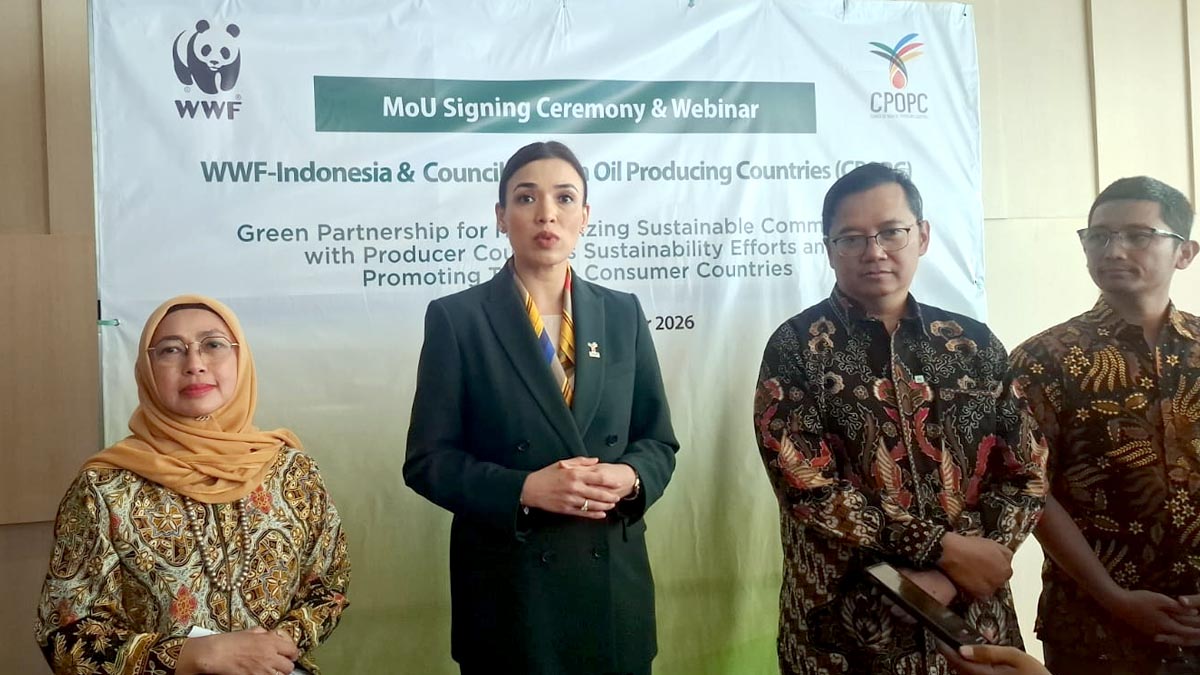
The cooperation will begin with knowledge sharing and subsequently develop into a number of joint programs. The collaboration will initially focus on WWF-Indonesia, with the potential to expand through WWF’s broader network and CPOPC member countries.
“The cooperation will begin with broad knowledge sharing, followed by several joint programs,” Izzana told PalmOilMagazine during a press conference on cooperation between WWF-Indonesia and CPOPC in Jakarta on Friday (Sept. 18, 2026).
She said the cooperation is important because advancing the sustainability agenda requires the involvement of palm oil-producing countries. Indonesia and Malaysia are key supporters of CPOPC, while other member countries also play a role in advancing the organization’s shared sustainability agenda.
Also Read: CPOPC Expands Smallholder Training Program to Malaysia to Boost Sustainable Palm Oil Production
CPOPC Deputy Secretary General Musdhalifah Machmud said producing countries have a shared interest in ensuring that smallholders receive support to improve both productivity and income.
“We also want to help smallholders increase their income, productivity and other aspects,” Musdhalifah said.
She said the sustainability of the palm oil industry cannot be separated from the livelihoods of communities that depend on the commodity. As a result, sustainability policies need to take into account the economic realities facing producing countries.
Producing countries also need to build evidence and reliable data that accurately reflect conditions on the ground, she said. Such information is important for strengthening communication with stakeholders involved in discussions on palm oil sustainability.
“We are working together to build evidence and strengthen responsibility toward all communities,” Musdhalifah said.
She added that communication among producing countries, civil society organizations and other stakeholders would remain important in developing a shared understanding of sustainability in the palm oil sector.
Also Read: WWF Indonesia Advocates for Sustainable Palm Oil and Farmer Prosperity at 7th ICOPE
Linking Sustainability With Market Access
Meanwhile, WWF-Indonesia CEO Aditya Bayunanda said there are areas of common ground between sustainability initiatives already being implemented in Indonesia and similar efforts at the global level.
The overlap provides an opportunity to scale up practices developed by sustainable palm oil producers, particularly by highlighting the industry’s role in supporting local economies and livelihoods.
Also Read: Managing Palm Oil in Forest Areas: WWF-Indonesia Advocates for Jangka Benah Approach
“We see a lot of overlap between the work being done in Indonesia and various efforts at the global level,” Aditya said.
He said WWF-Indonesia also sees evidence and statistics on the palm oil sector as important tools for building a more comprehensive understanding of the industry’s contribution.
Evidence-based information, he said, can help ensure that discussions about sustainability reflect actual conditions on the ground rather than relying solely on perceptions.
Also Read: Indonesia’s Palm Oil Consumption Hits 12.99 Million Tons, Boosting Sustainable Market
Aditya said WWF’s position has consistently been to promote market access for products produced through sustainable practices.
“We are very consistent. Our goal has always been to ensure market access so that producers investing in sustainability receive recognition and access to markets,” he said.
For palm oil-producing regions, such access is significant because the commodity remains an important source of economic growth and livelihoods.
Also Read: Beyond Certification: The Next Chapter of Indonesia’s Sustainable Palm Oil
Sustainability Beyond Compliance
The discussion highlights a broader challenge facing the palm oil industry: sustainability is not only about meeting environmental standards but also about ensuring that sustainably produced palm oil can retain access to international markets.
For smallholders, the issue is particularly significant because higher sustainability requirements can involve additional costs, administrative requirements and investments in production practices.
Also Read: Malaysia Palm Oil Faces EUDR Compliance Pressure as Traceability Gains Importance
Against this backdrop, higher productivity, stronger smallholder incomes, reliable and verifiable data, and market access are increasingly interconnected elements of the sustainability agenda.
The cooperation between palm oil-producing countries and organizations such as WWF-Indonesia is expected to strengthen the evidence base surrounding the industry while promoting sustainability approaches that take into account the millions of people whose livelihoods depend on palm oil. (P3)