The government’s forest-area enforcement program has brought millions of hectares of plantation land under state control, but PURAKA says the next challenge is ensuring legal certainty, transparent asset management and protection for communities dependent on the land.
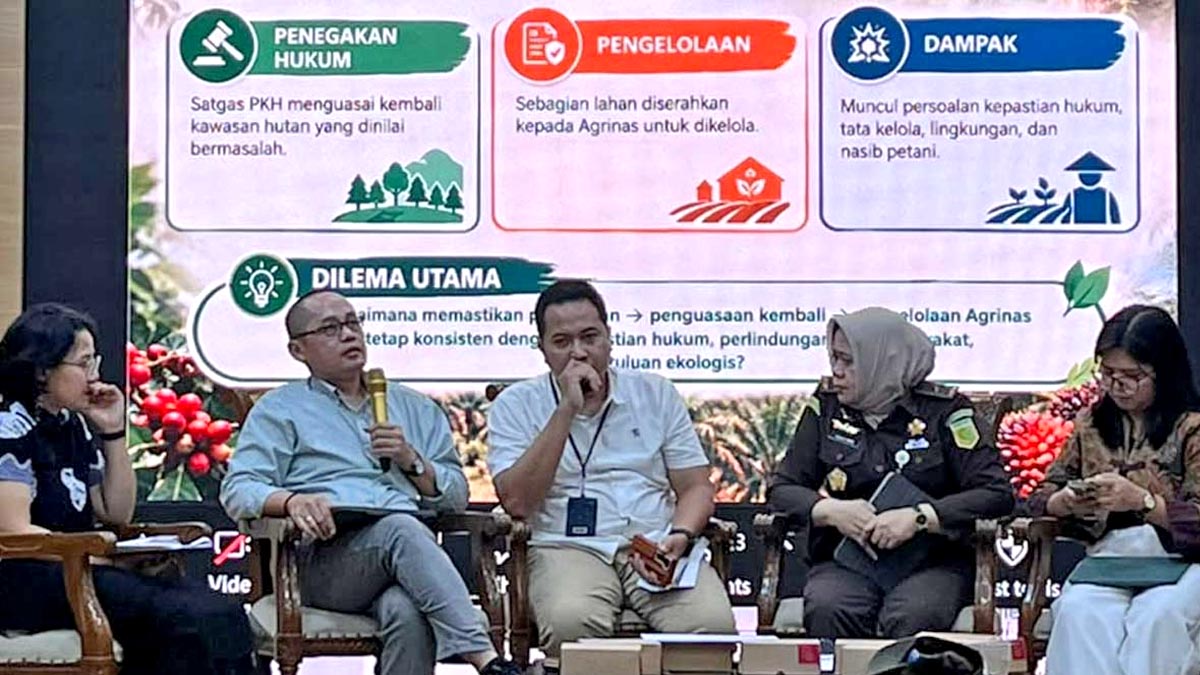
PALMOILMAGAZINE, JAKARTA — The management of plantation assets recovered through Indonesia’s forest-area enforcement program has emerged as a key issue at the Second National Smallholder Plantation Conference, with the Center for Law and Conflict Resolution (PURAKA) highlighting the legal and social implications of transferring large areas of land to state-owned Agrinas Palma Nusantara.
According to data presented by PURAKA at the conference on Thursday (Sept. 24, 2026), the Forest Area Enforcement Task Force (Satgas PKH) had recovered control of approximately 6.001 million hectares as of Sept. 7.
Also Read: PURAKA Warns Satgas PKH Plantation Seizures Do Not Automatically Resolve Land Status
Of that total, around 4.112 million hectares had been transferred to Agrinas, while approximately 1.031 million hectares had been handed over to the Ministry of Forestry/Environment. Another 857,366 hectares were reportedly still in the process of being transferred or had yet to be handed over.
PURAKA Head Ahmad Zazali said the scale of the recovered assets creates a significant governance challenge, particularly as the process moves from state repossession to long-term management.
For the plantation sector specifically, PURAKA data showed that approximately 5.889 million hectares of plantation areas had been recovered by the Satgas PKH. Of this amount, 4.113 million hectares had been transferred to Agrinas Palma Nusantara.
Also Read: CELIOS: Sulawesi Exceeded Environmental Limits as Mining, Palm Oil Expand
The figures illustrate the substantial scale of assets now requiring management following the forest-area enforcement process. PURAKA emphasized that the transition from recovery by the Satgas PKH to management by Agrinas raises questions concerning the legal status of the land, the legality of control and the position of communities that have historically cultivated or depended on the plantations.
Legal Certainty Needed Across Asset Management Chain
PURAKA outlined a management chain beginning with forest areas identified as problematic, followed by plantations deemed to be in violation, recovery of control by the Satgas PKH, transfer to Agrinas, and subsequent management either directly or through cooperation arrangements, including joint operating schemes (KSO).
The process ultimately requires clarification of the status of the forest area and land rights.
Also Read: Indonesian Smallholders Step Up Fire Patrols as Land Fires Spread
PURAKA stressed that each stage involves different legal bases, authorities, procedures and consequences. As a result, the recovery of control over an area does not automatically resolve the underlying status of the forest area or land rights.
The issue is particularly significant where plantations subject to enforcement overlap with areas that form part of local communities’ livelihoods.
According to PURAKA’s presentation, potential impacts on smallholders include loss of livelihoods, legal uncertainty, the risk of conflict and uncertainty over future partnership arrangements.
Also Read: PUSTAKA ALAM Questions Accuracy of Satgas PKH’s Palm Oil Land Reacquisition Data
Plantation Fines Reach IDR21.9 Trillion
In addition to land areas, PURAKA presented data on administrative fines imposed on oil palm plantations seized through the Satgas PKH enforcement process.
Potential administrative fines in the palm oil sector were estimated at approximately IDR21.9 trillion involving 134 companies.
Also Read: CPO Price Today (Sept. 29): KPBN Inacom Falls to IDR 15,050/Kg, Rotterdam Market Moves Mixed
Of that amount, around IDR11.4 trillion had been paid by 92 companies, while approximately IDR10.5 trillion remained unpaid. PURAKA also reported that around IDR10.27 trillion had entered the state treasury.
The presentation also highlighted the financial performance of Agrinas in managing state plantation assets.
Agrinas reportedly generated an operating surplus of approximately IDR2.86 trillion from plantation asset management in fiscal year 2025, while the company recorded net profit of around IDR27.9 billion.
These figures formed part of PURAKA’s assessment of the economic scale of managing plantation assets recovered through the forest-area enforcement program.
Also Read: Indonesia’s Palm Oil Smallholders: 3 Key Demands to the Government
Smallholders Seek Clarity Over Land Status
For smallholder plantations, the developments make land-status certainty a central issue.
PURAKA called for the forest-area enforcement process to go beyond the recovery of assets and establish mechanisms that provide legal certainty and protect communities with legitimate claims to, or livelihood dependence on, the affected land.
Also Read: New Palm Oil Mill Breaks Ground in Bangka, Investment Expected to Create Jobs
The organization emphasized that the transition from enforcement to asset management needs to take into account the legal status of land, existing rights and the position of communities to minimize uncertainty and potential conflict.
The issue is expected to remain important as the government moves toward managing and determining the future use of millions of hectares of plantation assets recovered through the forest-area enforcement program. (P2)