
The government is fast-tracking the National Strategic Project on palm oil governance, with a focus on legal certainty for smallholder plantations, access to replanting programs and stronger community partnerships.
PALMOILMAGAZINE, JAKARTA — The Indonesian government is accelerating the implementation of a National Strategic Project (PSN) aimed at strengthening the governance and agribusiness ecosystem of the country’s palm oil sector, placing legal certainty for smallholder plantations, farmer welfare and inclusive partnerships at the center of the initiative.
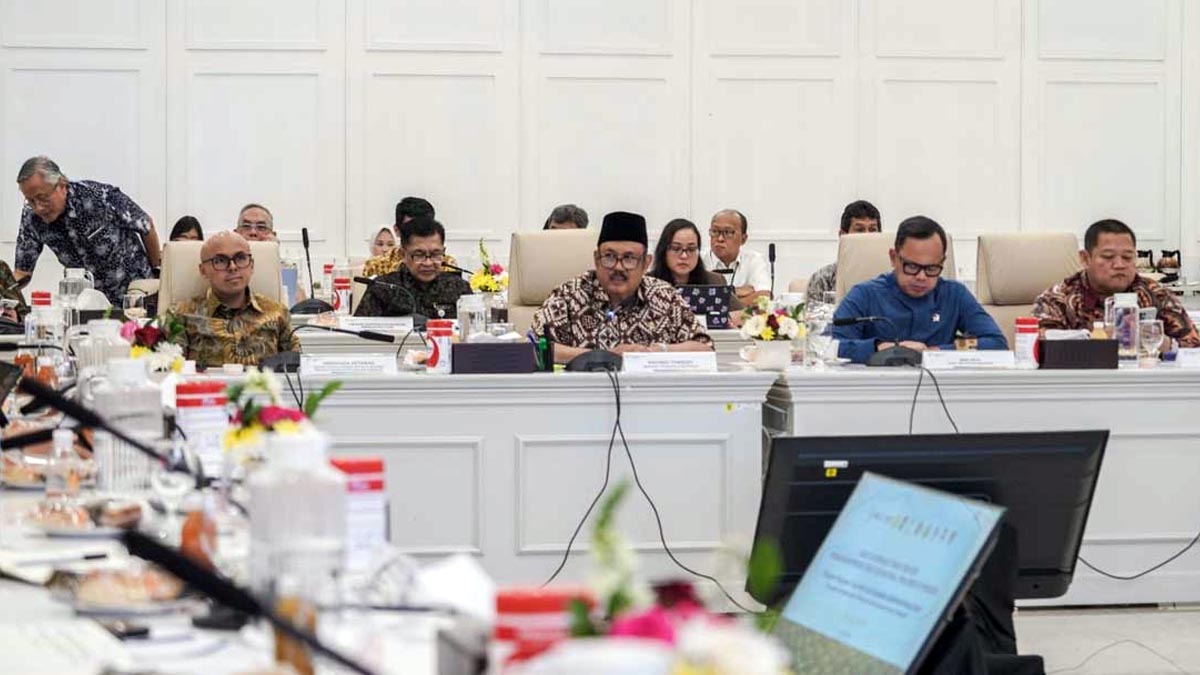
The move follows a directive from Indonesian President discussed at a ministerial-level coordination meeting at the Ministry of National Development Planning (Bappenas) on Friday (Oct. 16, 2026).
Also Read: Is Palm Industry The Real Culprit Behind Forest and Land Fires?
The cross-ministerial consolidation focused on land tenure as a foundation for improving the governance of Indonesia’s palm oil industry and creating a more equitable and sustainable plantation sector.
Minister of National Development Planning and Head of Bappenas Rachmat Pambudy said palm oil plantation restructuring must provide legal certainty while expanding smallholders’ access to productivity-enhancement programs.
He described palm oil as a strategic national commodity whose management should deliver tangible benefits to communities.
Also Read: Bengkulu Oil Palm Smallholders Trained to Make Organic Fertilizer and Cut Production Costs
“The state is fully present to provide security and agrarian justice for farmers who depend on palm oil plantations for their livelihoods,” Rachmat said in an official statement received by PalmOilMagazine on Monday (Oct. 26).
He said the restructuring of smallholder plantations should also create broader opportunities for farmers to increase productivity through the Smallholder Palm Oil Replanting Program, or Peremajaan Sawit Rakyat (PSR).
Legal Certainty and Faster Smallholder Replanting
A key component of the PSN is accelerating the resolution of legal issues involving smallholder palm oil plantations located within forest areas.
The government said the restructuring of smallholder plantations — whether operated under partnership arrangements or independently — must be carried out fairly while complying with applicable laws and regulations.
The government is also seeking a dedicated pathway for resolving smallholder plantation issues so that farmers’ legal status can be addressed separately from land-control issues involving corporations.
Once land legality and tenure issues have been resolved in accordance with prevailing regulations, smallholders are expected to gain broader access to PSR, a government program designed to rejuvenate aging plantations, improve productivity and support farmers’ long-term incomes.
The Ministry of Forestry is expected to accelerate the recognition process and adjustment of forest-area boundaries to support the resolution of smallholder land issues.
Also Read: Oil Palm Smallholders Urged to Choose Certified Seedlings for Higher Productivity
The approach is directed toward plantations of up to five hectares that have been sustainably managed for more than two decades, while remaining subject to applicable legal and regulatory requirements.
The Ministry of Agrarian Affairs and Spatial Planning/National Land Agency (ATR/BPN), meanwhile, will support the issuance of land certificates through agrarian reform programs for parcels that meet the relevant requirements.
For individually managed plantations meeting the minimum five-year tenure criteria, the government is directing the resolution process through area-restructuring mechanisms in accordance with prevailing regulations.
The approach is intended to strengthen farmers’ legal protection while maintaining accountability and regulatory compliance.
Local Governments Asked to Speed Up Administration
The acceleration of the palm oil PSN will also require stronger involvement from local governments, particularly in completing land administration and plantation-business documentation for smallholders.
The Ministry of Home Affairs will issue directions to regional heads in areas covered by the PSN to accelerate administrative services while maintaining accountability.
The process includes facilitating land-restructuring applications, issuing land-history documents, preparing the Surat Pernyataan Penguasaan Fisik Bidang Tanah (SP2FBT), and collectively issuing electronic Surat Tanda Daftar Budidaya (e-STDB) documents for eligible smallholders.
These documents are considered important for improving administrative governance in smallholder plantations.
More reliable land and plantation records could help the government strengthen farmer assistance while expanding access to plantation development programs.
For independent smallholders, faster administrative processing could also support stronger farmer institutions and improve access to government programs. Implementation, however, will continue to depend on the fulfillment of legal and administrative requirements in each region.
Agrinas Palma Nusantara Asked to Strengthen Inclusive Partnerships
Beyond resolving smallholder plantation issues, the government is also seeking to ensure that state plantation land generates broader economic benefits for surrounding communities.
Under the discussions, management of plantation land by PT Agrinas Palma Nusantara (APN) in the former PT Torganda area is being directed toward greater community participation through partnership arrangements.
Development of the area is expected to receive investment support from the state-owned enterprise regulatory authority and BPI Danantara Indonesia following the completion of the area’s legal and administrative status by the relevant ministries.
PT APN has been directed to allocate at least 20% of the plantation area for local communities and establish inclusive partnerships with local community cooperatives.
The arrangement is intended not only to increase community participation in plantation activities but also to strengthen the role of cooperatives in the palm oil value chain.
Transparent and sustainable partnership structures could help ensure that the management of state plantation assets generates more broadly distributed economic benefits.
However, the effectiveness of the policy will depend heavily on the partnership mechanism, clarity over the rights and responsibilities of each party, and effective oversight of how economic benefits are distributed among participating communities.
Government Proposes National Palm Oil Agency
The ministerial-level coordination meeting also proposed establishing a National Palm Oil Agency reporting directly to the President to strengthen policy coordination across the palm oil value chain.
The proposed institution could serve as a strategic coordination mechanism covering smallholder protection, cross-sector policy integration, supply-chain development and the international competitiveness of Indonesia’s palm oil industry.
The establishment of the agency remains a strategic recommendation under discussion and has not yet become an implemented institutional framework. Its implementation will depend on subsequent government decisions and policy follow-up.
All recommendations from the coordination meeting will be consolidated and periodically reported to the President as input for further policymaking.
The acceleration of the palm oil PSN places smallholder plantation legality, access to replanting programs and inclusive partnerships at the center of efforts to reform the sector.
Its success, however, will ultimately depend on consistent implementation on the ground, effective coordination among government agencies and the government’s ability to ensure that the benefits of plantation restructuring reach smallholders and communities surrounding plantation areas. (P2)