
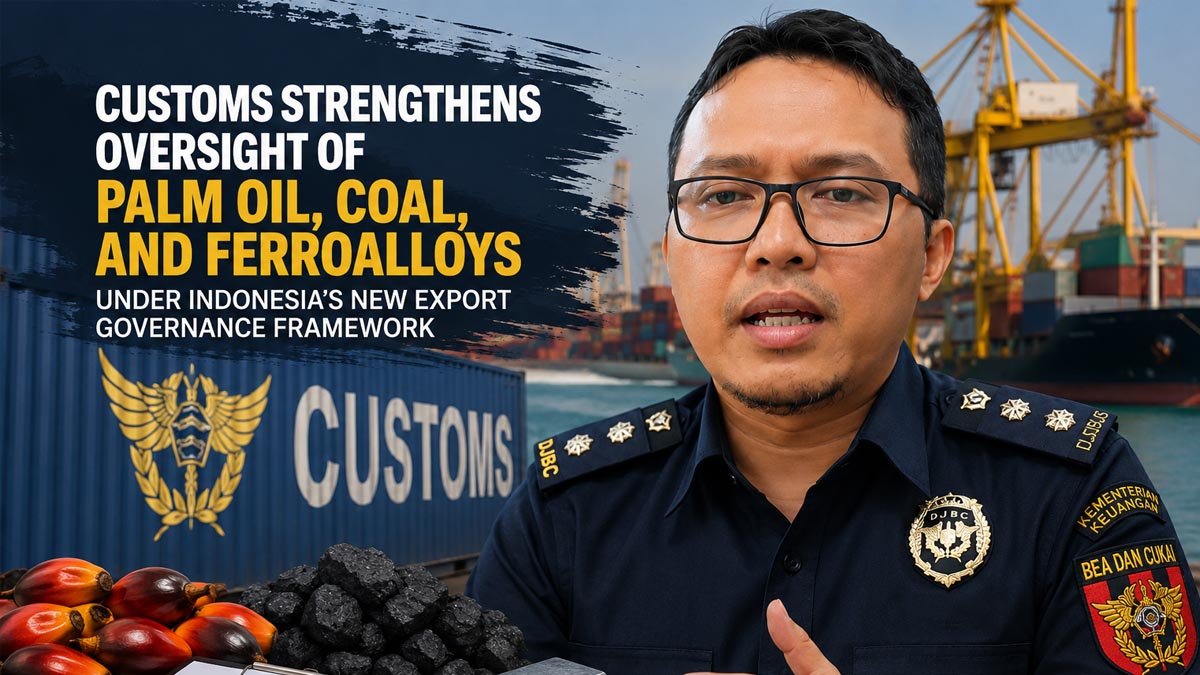
PALMOILMAGAZINE, JAKARTA – Indonesia’s Directorate General of Customs and Excise or Direktorat Jenderal Bea dan Cukai (DJBC) has confirmed its readiness to implement the new governance framework for strategic natural resource exports under Government Regulation (PP) No. 24 of 2026. The policy covers three key commodities—palm oil, coal, and ferroalloys—which are now subject to integrated supervision involving multiple ministries and government agencies.
The announcement was made by Agus Budi Priyono of DJBC’s Customs Technical Directorate during a public outreach session on the Ministry of Trade’s regulations governing the export of strategic natural resources on Tuesday (June 9, 2026).
According to Agus, Government Regulation No. 24 of 2026 establishes a new legal foundation for regulating exports of strategic commodities while mandating stronger coordination among relevant government institutions.
Also Read: Indonesia’s CPO Price Slips as Malaysian Palm Oil Futures Decline Ahead of MPOB Report
“The commodities covered under this export governance framework include coal, palm oil in the form of crude palm oil (CPO) and its derivatives, as well as ferroalloys,” Agus explained.
Following the issuance of the regulation, the government introduced several implementing rules, including new Ministry of Trade regulations that were subsequently supported by decisions issued by the Ministry of Finance.
To facilitate implementation, DJBC has issued three Minister of Finance Decrees (KMK). KMK No. 31 of 2026 supports regulations governing coal exports, KMK No. 33 of 2026 covers palm oil exports, while KMK No. 32 of 2026 supports the export framework for ferroalloys.
“These regulations have been distributed to all Customs offices and the National Single Window Agency to ensure export management and supervision can be carried out automatically through integrated digital systems,” Agus said.
He emphasized that DJBC’s role extends beyond border control, encompassing efforts to safeguard domestic supply chain stability and ensure exporters comply with applicable regulations.
The provisions also apply within bonded zones, Special Economic Zones (SEZs), and Free Trade and Free Port Areas. Export declarations for strategic commodities must therefore continue to satisfy licensing requirements stipulated in the relevant trade regulations.
“As long as all requirements are fulfilled, export approvals can still be granted for goods leaving the customs territory,” Agus noted.
The government has established a transition period through December 31, 2026. While PP No. 24 of 2026 was enacted on May 20 and the governance provisions took effect on June 1, full implementation of the new system is scheduled to begin on January 1, 2027.
During the transition phase, exporters may continue using existing reporting mechanisms while complying with additional reporting obligations. One of the key changes is the introduction of a checkbox feature within the customs system, allowing exporters to authorize the submission of export data to the Plantation Fund Management Agency (BPDP), which manages the monitoring of export proceeds from natural resources (DHE SDA).
Also Read: Minister Amran Warns Up to 300 Palm Oil Firms Over Depressed FFB Prices Despite Rising CPO Market
“Overall, customs procedures remain largely unchanged. The primary addition is reporting obligations, while the rest of the process continues under the existing framework,” Agus explained.
The checkbox feature will appear when exporters submit export documentation for commodities covered by PP No. 24 of 2026. Relevant export data will then be transmitted in accordance with regulatory requirements.
However, Agus stressed that not all products using specific Harmonized System (HS) codes will automatically be reported. The system has been calibrated to ensure that only exports falling within the scope of the regulation are included.
Also Read: Indonesia and EU Fast-Track IEU-CEPA Ratification, Target Early 2027 Implementation
“For commodities outside the scope of PP No. 24 of 2026, the data will not be transmitted. The filtering mechanism remains based on designated HS code classifications,” he said.
To support implementation, DJBC has undertaken a range of preparatory measures, including regulatory adjustments, customs system upgrades, and intensive coordination with related institutions.
Updates to the CEISA 4.0 customs platform include algorithm enhancements and revised HS code references to improve identification of strategic commodities subject to monitoring. DJBC has also worked closely with the National Single Window Agency and the Ministry of Trade to ensure that permit validation can be conducted automatically through integrated systems.
Also Read: POPSI Warns PP 24/2026 Could Increase Costs and Pressure Palm Oil Smallholders
“We have also carried out extensive outreach activities, both internally within Customs and among business stakeholders. Our objective is to ensure the effective implementation of strategic natural resource export governance while providing legal certainty for all exporters,” Agus concluded. (P2)