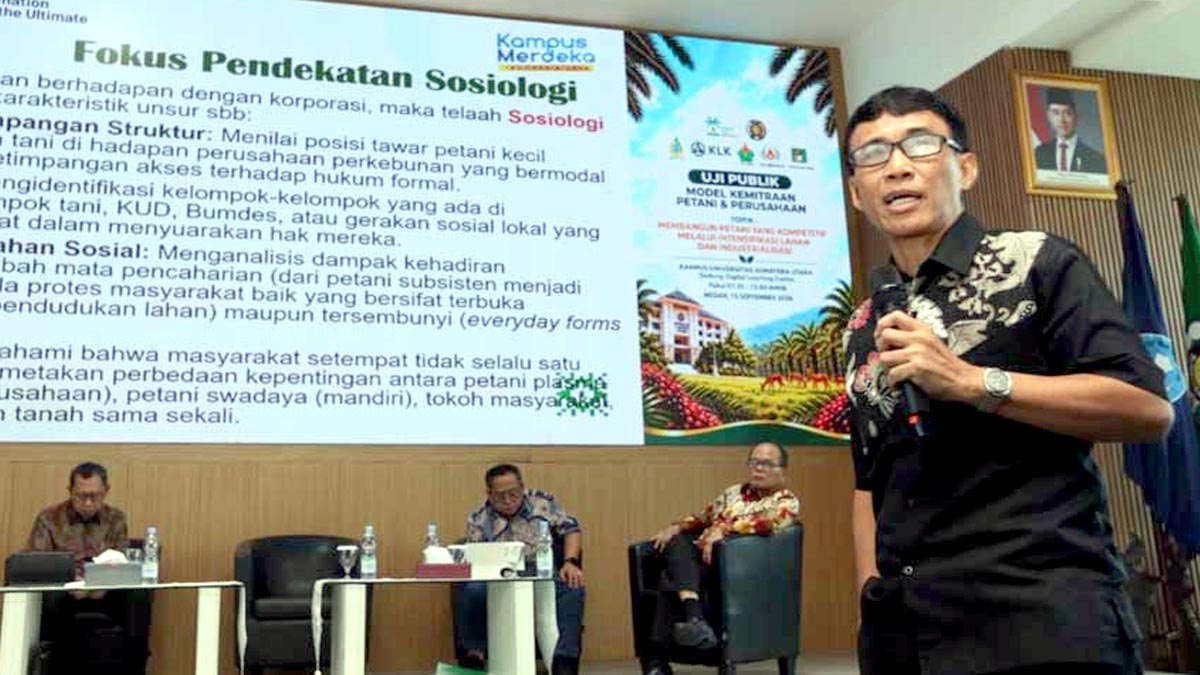
USU researchers say understanding local social structures, land values and power relations is essential to preventing conflicts between palm oil companies and smallholders.
PALMOILMAGAZINE, MEDAN — Partnerships between palm oil companies and local communities can sometimes lead to prolonged conflicts, highlighting the need for stronger sociological and anthropological approaches in designing fairer and more sustainable cooperation models.
Yusak Maryunianta, a socio-economic researcher at Universitas Sumatera Utara (USU), said efforts to resolve conflicts and establish partnerships between palm oil smallholders and companies have often relied primarily on formal legal and regulatory mechanisms or material considerations.
Also Read: WWF-Indonesia and CPOPC Strengthen Sustainable Commodity Supply Chains
Such approaches, he said, may overlook the broader social and cultural consequences of land-related disputes.
“When building partnerships or resolving conflicts between smallholders and plantation companies, businesses often rely mainly on formal legal and regulatory mechanisms or material approaches,” Yusak said during a public consultation at USU in Medan on Sept. 15, according to an official statement received by PalmOilMagazine.
He said disputes that initially arise from palm oil partnership arrangements can eventually threaten local social relations and community structures, potentially affecting cultural identity, belief systems and people’s living spaces.
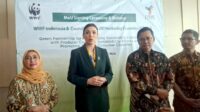
The discussion, organised by Rumah Sawit Indonesia (RSI) and USU, was titled “Farmer-Company Partnerships in Building Reliable and Competitive Farmers through Land Intensification and Industrialisation.”
Mapping Power Relations and Social Conflict
Yusak said developing fair and sustainable partnerships should begin with a clear understanding of the characteristics of local communities.
When rural communities interact with corporations, a sociological assessment should examine power relations and structural inequalities, local institutions, conflict dynamics and social differentiation within the community.
Also Read: CPOPC and WWF-Indonesia Link Palm Oil Sustainability to Smallholder Income
Such an approach would ensure that partnerships are not viewed solely as economic relationships between companies and farmers. Local social structures and relationships among stakeholders should also be considered when designing cooperation models.
Anthropology can provide another layer of understanding, particularly regarding the non-economic dimensions of land ownership and use.
“For local and indigenous communities, land is not merely a productive asset. It can also have spiritual, historical and social dimensions that serve as a foundation of collective identity,” Yusak said.
Also Read: KPBN Inacom CPO Price Falls IDR50 to IDR15,708/kg, Malaysia CPO Also Weakens
For some communities, he added, land can be closely associated with ancestral heritage, community history and collective identity.
The loss of land can therefore have consequences extending well beyond the loss of an economic asset, potentially affecting cultural continuity and the community’s living environment.
USU Urged to Develop Strategic Palm Oil Research Centre
During the same discussion, RSI Chairman Kacuk Sumarto called on universities to play a greater role in developing strategic research on Indonesia’s palm oil industry.
He said USU could serve as a foundation for establishing a palm oil think tank that produces research and policy recommendations for the government.
Also Read: Malaysia CPO Falls 0.77% to RM4,898/Ton Friday (18/9), Global Vegetable Oils Weaken
Such an institution could contribute not only to palm oil policy discussions but also to proposals for new legislation and reviews of existing regulations affecting the commodity.
“The government needs objective input from academic institutions so that ideas about the future of the palm oil industry, including strengthening the role of farmers, can be translated into regulations,” Kacuk said.
He said academic involvement would help ensure that palm oil policies are supported by scientific research and objective perspectives, including efforts to strengthen smallholders’ position within the national palm oil value chain.
Also Read: India’s Palm Oil Imports Rise 7% in August to Six-Month High
USU Has Strong Academic Foundation
Seger Budiharjo, director of PT Agrinas Palma Nusantara (APN), also supported the development of a strategic palm oil research institution within universities, including USU.
He said USU was well positioned to take on such a role given North Sumatra’s historical importance to the development of Indonesia’s palm oil industry.
Also Read: Indonesia’s CPO, Palm Oil Derivative Exports Rise 5.49% in January–July 2026
“I believe USU is well positioned to become a university that focuses on scientific research into palm oil, given that Indonesia’s first palm oil plantation was established in North Sumatra. USU also has experts from many different disciplines,” Seger said during the RSI-USU public consultation.
According to Seger, the university’s multidisciplinary expertise could support research covering not only plantation management but also economics, social affairs, law, technology and public policy.
He also stressed the importance of farmers in shaping the future of Indonesia’s palm oil industry. Strengthening farmer institutions, he said, should go hand in hand with improving partnership models between farmers and plantation companies.
Increasing productivity through the People’s Palm Oil Replanting (PSR) programme should also remain a priority, he added. (P2)