Science confirms that oil palm is not the most water-hungry crop on earth. But that fact alone does not explain why villages near plantations are flooding more often and drying out faster than ever before. That is where the real problem lies.
By Ts. Dr. Muhamad Askari
Indonesian Diaspora • Senior Lecturer, Faculty of Sustainable Agriculture, Universiti Malaysia Sabah • Agricultural Hydrologist
PALMOILMAGAZINE, JAKARTA – Picture two neighbours in the same village. Both draw water from the same well. The first drinks a great deal — but from his kitchen, the whole street gets fed. The second drinks sparingly — but his harvest is barely enough for himself, let alone to share. So who, honestly, deserves to be called greedy?
That image captures the long and unresolved debate between oil palm and water in this country. On social media, oil palm is put on trial with no mercy: accused of draining rivers, drying out community wells, and bearing sole responsibility for every drought disaster. On the other side, the oil palm industry defends itself with data, arguing that its crop actually uses less water than many others we never question. Between those two equally passionate camps, science — slow, careful, and undramatic — is gradually offering an answer that is more honest, and considerably more complicated, than either side would like.
Where Did the ‘Water-Guzzler’ Label Come From?
Before we pass judgment on oil palm, it is worth asking a basic question first: where exactly did the term ‘water-guzzler’ come from? Who first used it, and what is the measuring stick? As it turns out, there is no official definition for that label anywhere. There is no chapter titled ‘List of Water-Guzzling Crops’ in the official evapotranspiration guidelines published by the Food and Agriculture Organization of the United Nations — the guide written by Richard G. Allen that agricultural engineers around the world treat as their standard reference. Nor does such a chapter exist in Daniel Hillel’s classic textbook on soil physics, reprinted dozens of times across decades. What do exist are two scientific concepts that the public has long misunderstood.
The first concept is called evapotranspiration — a long word for something that is actually very easy to picture. Watch a tree in your garden after a heavy downpour. Water soaks into the soil, gets drawn up by the roots, travels through the trunk, climbs into the branches, and eventually escapes as vapour through the tiny pores on the surface of every leaf — the way sweat evaporates from our skin on a hot day. That combined process — evaporation from the soil surface plus the ‘sweating’ of the plant’s leaves — is what scientists call evapotranspiration, or ET for short. The broader and denser a plant’s leaves, the more it sweats. This is why plants that grow year-round in the humid tropics naturally consume more water than seasonal crops that sprout, fruit, and die within a few months.
The second concept has nothing to do with the plant itself — it is about the soil: specifically, how much water it can hold before running dry. Sandy soil, with its coarse and loosely packed grains, holds water like a bucket with a hole in it — it fills quickly and empties just as fast. Clay-rich soil full of organic matter, on the other hand, works like a thick sponge — slow to fill, but also very slow to dry out. And soil that has been compacted hard by heavy machinery holds no water at all — it simply rejects it, forcing the water to run off across the surface and carry away whatever it finds.
The conclusion, then, is this: ‘water-guzzling’ is not purely a trait of the plant. It is the product of an entire system — the type of crop, the condition of the soil, and the climate working together. Pinning that label on a single crop without looking at its system context is like blaming the kitchen tap for a sky-high water bill when there is actually a burst pipe hidden behind the wall.
Also Read: Bappenas Pushes IPB to Become Hub of Palm Oil Innovation and Downstream Development
The Numbers Don’t Lie: Where Does Oil Palm Actually Stand?
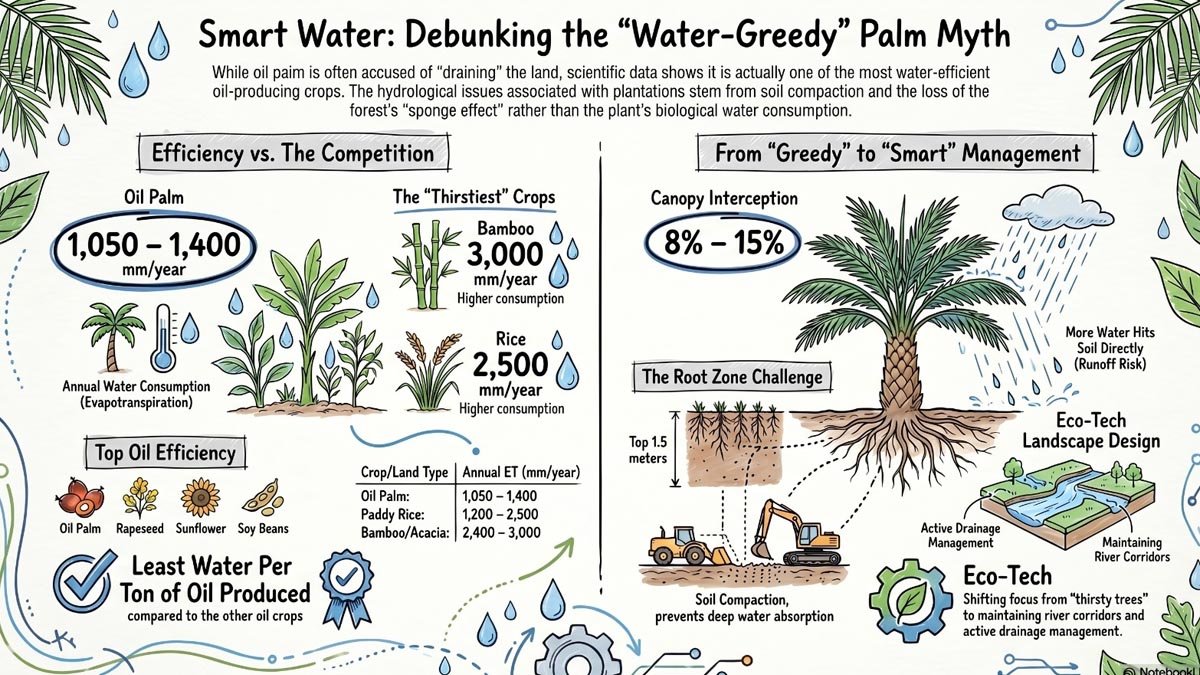
Let us look at the real figures. Researchers use a technique called sap-flux to measure exactly how much water an oil palm tree actually consumes. The method is straightforward to visualise: a small sensor is inserted into the trunk of the tree and measures how fast water is flowing upward from the roots to the leaves — much like a digital thermometer measuring the pulse of blood flowing through the body. Using this technique, combined with water-balance measurements taken across oil palm plantations in Sumatra and Kalimantan, researchers arrived at a figure that surprised many people: the annual evapotranspiration of an oil palm plantation ranges between 1,050 and 1,400 millimetres per year.
To appreciate what that number means, we need to compare it against crops we already know. It turns out that oil palm consumes roughly the same amount of water as the tropical rainforest it so often replaces — not dramatically more, as many had assumed. Acacia plantations grown for the paper industry or stretches of bamboo that look lush and ‘natural’, can actually evaporate between 2,400 and 3,000 millimetres of water per year — nearly double that of oil palm. And what about wet-field rice, which has been farmed here for centuries? It consumes between 1,200 and 2,500 millimetres per year — comparable to oil palm, or even higher, depending on the season and how it is managed.
Also Read: Agriculture Ministry Presses 139 Palm Oil Mills to Reverse FFB Price Cuts
The global water-footprint study published by the Food and Agriculture Organization (FAO) goes even further. Rather than simply counting how much water oil palm drinks, they measured how much oil can be produced from every litre of that water. The result: oil palm is one of the most water-efficient oil crops in the world. To produce one tonne of oil, oil palm requires far less water than rapeseed, which dominates European farmland, than sunflower, planted across Central Asia, or than soybean, which covers tens of millions of hectares across South America.
“If the yardstick is how many litres of oil can be produced per litre of water used, oil palm actually qualifies as efficient. The real problem only emerges when we stop looking at a single tree and start looking at an entire river catchment hundreds of kilometres long.”
The Secret Is Not How Much Is Drunk — But How Water Moves
This is the heart of the problem, and it is the part most often missing from the noisy public debate. Researchers from Germany and Indonesia who studied various tropical landscapes discovered something critically important: the total water consumption of oil palm and forest can indeed be almost equal, but the way water moves through the river catchment changes drastically once forest is replaced by oil palm plantation. And it is that difference in movement — not the raw consumption figure — that decides whether a river runs quietly or bursts its banks, whether a village well stays full or goes dry.
Tropical rainforest works like a brilliantly engineered, multi-layered absorption system. Imagine standing inside a dense forest during a heavy storm. You barely feel the rain directly on your skin — because the layered canopy overhead catches 15 to 25 percent of all the water falling from the sky. That intercepted water clings to the leaves and evaporates back into the air before it ever touches the ground, which means the soil below receives a far gentler, more manageable amount to absorb. Underground, the roots of forest trees reach deep — some penetrating fractured rock layers — so the forest can keep drawing from deep groundwater reserves even during the most brutal dry season. The soil itself, undisturbed and rich in organic matter, lets rainwater percolate slowly down through layer after layer, stored like water in an invisible underground reservoir, then released steadily as a reliable baseflow that keeps rivers running for months after the last rain has fallen.
Also Read: Indonesia Sets June CPO Reference Price at USD 1,029.51/MT Amid Softer Global Demand
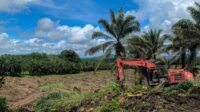
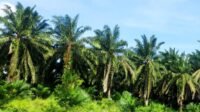
An oil palm plantation works very differently, even when its water consumption numbers look similar on paper. The fronds of an oil palm can only intercept 8 to 15 percent of rainfall — half or even a third of what a forest canopy manages. The remaining 85 to 92 percent of all rainfall hits the ground directly, at full force, like water poured from a large bucket with no filter. The roots of an oil palm are also far shallower than those of forest trees: most are concentrated in the top 0 to 1.5 metres of soil — a layer no thicker than the height of a mattress. Once that thin layer dries out during a prolonged dry spell or hardens because harvest vehicles have been driving over it for years, the oil palm can no longer reach the deeper water reserves that a forest would tap into.
And then there is a third problem that makes everything worse: the soil along harvest tracks, driven over by heavy vehicles twice a month, grows more compacted and harder year after year — like clay that has been stomped and stamped until it turns as solid as a brick. Soil in that condition repels water. Rain that falls on it does not soak in — it rushes across the surface instead, scraping up and carrying away the most fertile topsoil down into drainage channels. The consequence is a pattern seen repeatedly across tropical river catchments now filled with plantations: floods peak higher during heavy rain, and rivers dry up faster when the rain stops. Not because oil palm is drinking more than the forest once did. But because the entire journey water takes from sky to river has been fundamentally changed.
“Forest and oil palm can drink almost the same amount of water. The difference is that forest stores it first, then releases it slowly into the river all year long. An oil palm plantation with compacted soil sends water rushing straight to the surface — fast, forceful, and leaving the land drier in its wake.”
So, Water-Guzzler or Not? Here Is the More Honest Answer
The answer is not a simple yes or no, and anyone who claims otherwise is almost certainly simplifying a complex reality to win an argument. From a botanical standpoint, oil palm is genuinely not the most water-wasteful crop — the data are clear on that. From an agricultural economics standpoint, its ability to generate oil per litre of water used is difficult for any other oil crop in the world to match. But when millions of hectares of primary forest — with its healthy soil, deep roots, and thick humus layer intact — are cleared and replaced by oil palm without serious landscape planning, the hydrological consequences are real and can be felt directly by the people living nearby.
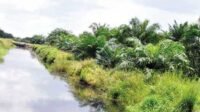
Rivers that used to flow relatively calmly now overflow their banks more frequently with every heavy rain, because water that once had time to soak slowly into the ground now races across the surface and arrives at the river all at once. Those same rivers dry up faster when the dry season comes, because the groundwater reserves that used to refill them from below have shrunk. And shallow wells in villages near the plantations run dry more often every year — not because anyone is stealing their water, but because the soil layer that used to absorb and store rainwater for them can no longer do its job.
Also Read: Sudaryono Meets Palm Oil Industry Players, Calls for Normal Trade Activities and Fair FFB Pricing
Organisations like the International Commission on Irrigation and Drainage (ICID) and the FAO have long cautioned that judging a crop’s impact on water availability from a single evapotranspiration figure alone is a dangerous oversimplification. It is like assessing someone’s health only by their body weight, without checking blood pressure, diet, or lifestyle. What matters far more is how we design and manage the entire agricultural landscape: where forest is preserved, where plantations can grow, and how water is managed between the two.
What Can We Do? Start With What We Already Know
The encouraging news is that the solutions do not require shutting down the entire oil palm industry, and they do not demand futuristic technology that does not yet exist. There are practical, science-backed steps that have already been tested and proven, and that can be started without waiting for new regulations.
The first and most fundamental step is to preserve forest corridors along riverbanks and in areas that naturally serve as water-catchment buffer zones. Those narrow green strips that some plantation managers dismiss as economically wasteful are in fact irreplaceable hydrological buffers. Their strong roots anchor the riverbanks against collapse during heavy rain. Their undisturbed soil absorbs a portion of potential floodwater before it can surge into downstream villages. And their shade keeps river water temperatures stable, protecting the aquatic life from overheating. Once those corridors are cleared to push the plantation right to the water’s edge, every one of those functions is permanently lost — and no technology can restore them as quickly as a forest that has been quietly building itself for hundreds of years.
Also Read: Indonesia Eyes Single-Gate CPO Export System to Curb Revenue Leakages
The second step is to reduce soil compaction inside the plantation itself. This is not about replacing all vehicles with more expensive ones. It is about changing habits that can be adjusted starting tomorrow morning. Rotating harvest tracks so that soil gets a rest between passes. Spreading pruned fronds and empty fruit bunches from the mill along harvest tracks as a natural protective layer that also slowly decomposes into new organic matter. Choosing wider tyres so that the weight of machinery is distributed over a larger area rather than concentrated on a single narrow strip. All of this has already been recommended by the Malaysian Palm Oil Board (MPOB) and the Indonesian Oil Palm Research Institute (IOPRI) — the knowledge is there; what is lacking is the consistent will to apply it.
The third step is to rethink how water is treated inside the plantation. For years, oil palm estates have been managed on the principle of ‘drain water away as fast as possible’ to prevent waterlogging that damages roots and complicates harvesting. But when applied too aggressively, that very principle makes the plantation itself more vulnerable to drought in the dry season and more vulnerable to flooding in the wet season, because no water is being retained within the land at all. Managing water channels with adjustable gates that respond to seasonal conditions, building small retention ponds at strategic points to hold rainwater longer within the landscape — none of this is a luxury. It is a long-term investment that protects the plantation itself from droughts that are becoming increasingly difficult to predict.
Also Read: Indonesia Warns Palm Oil Mills Over FFB Underpricing, Threatens License Revocations
A More Important Question Than ‘Greedy or Not’
For Indonesia, the debate over oil palm and water is not merely an academic exchange between scientists publishing in journals that only other scientists will read. It is about villages that flood every December and bake every August, while their residents are never consulted about the land-use decisions being made around them. It is about smallholder farmers who spend more money every year digging their wells deeper, because the groundwater that was always there is now increasingly hard to find. It is about rivers in Kalimantan and Sumatra that run thick brown even outside of the rainy season — a sign that there is no longer enough healthy soil left to filter the sediment before it reaches the water.
Oil palm is not the sole villain in this story. Irrigated rice with its enormous water demands, thirsty sugarcane, and even most industrial timber plantations can use far more water than a well-managed oil palm estate. The efficiency advantage of oil palm as an oil crop only becomes genuinely meaningful if its expansion is controlled seriously, if its farming practices truly follow the latest research that already exists, and if its water management honestly moves beyond ‘let it flow wherever it goes’ to ‘manage it carefully and responsibly.’
Because the right question is no longer ‘is oil palm a water-guzzler?’ — it is ‘are we smart enough to manage water in the landscape where oil palm grows?’ If we can one day answer ‘yes’ honestly, and back it up with real evidence, perhaps the labels ‘greedy’ and ‘efficient’ will no longer matter. What we need is not victory in a debate — what we need is an agricultural system that is fair to water: to the farmers who depend on it to live, to the rivers that have been flowing since long before the first plantation was opened, and to the generations who will inherit this earth long after all of us are gone.
Scientific Note
This opinion article draws on data from a number of peer-reviewed scientific sources. Evapotranspiration data for oil palm plantations were obtained from field studies using the sap-flux technique conducted in Sumatra and Kalimantan, Indonesia. The concepts of evapotranspiration and crop coefficients follow the FAO-56 guidelines compiled by Richard G. Allen and colleagues, as well as the soil physics textbook by Daniel Hillel. Soil water-storage capacity data are drawn from records of the Natural Resources Conservation Service under the United States Department of Agriculture. Comparative data on forest and oil palm canopy interception are sourced from tropical landscape studies conducted by researchers from Germany and Indonesia. Water efficiency and global water-footprint data are referenced from the FAO’s 2020 publication. Landscape management and drainage recommendations follow guidelines from the International Commission on Irrigation and Drainage, the Malaysian Palm Oil Board (MPOB), and the Indonesian Oil Palm Research Institute (IOPRI).