Conclusion: Restoring Cooperatives to Their True Purpose
Belayan Sejahtera is not a finished success story.
Our cooperative continues to depend on private palm oil mills. We have yet to enter the downstream processing industry where much of the value in the palm oil supply chain is created. Our governance, member participation, professionalism, and worker protection must continue to improve as the organization grows.
Yet our experience demonstrates what cooperatives are capable of achieving when they develop from genuine economic needs rather than administrative design.
Over the past two decades, Belayan Sejahtera has evolved from a cooperative that merely marketed fresh fruit bunches into an organization that manages multiple segments of the rural economy. It has grown from facilitating partnerships with companies to building its own productive assets, strengthening institutional capacity, and expanding the range of services available to its members.
Certification, once viewed primarily as a costly compliance exercise, has become an instrument for acquiring knowledge, strengthening governance, improving market access, and building long-term economic assets within the community.
This, in our view, is the true evolution of a cooperative.
A cooperative should neither stand outside the market nor simply submit to it.
Rather, it should strengthen the position of farmers within the market itself.
It should not reject private enterprise but insist upon partnerships founded on fairness, transparency, and mutual benefit.
Nor should it seek to replace the role of the state. Instead, it should expect government to intervene where it matters most: by correcting structural imbalances, expanding economic opportunity, and ensuring that smallholders possess the institutional capacity to compete on more equal terms.
At the same time, our experience also reveals the limits that remain.
As long as farmer cooperatives are confined to selling fresh fruit bunches, the largest share of value creation will continue to occur in processing, refining, and downstream manufacturing. Capturing greater value therefore requires the cooperative movement to pursue a new stage of development.
The next phase cannot be achieved by individual cooperatives acting alone.
It will require stronger cooperation among cooperatives themselves.
Through inter-cooperative alliances, organizations can consolidate production, strengthen financing, share technology, develop professional management, and invest collectively in processing facilities that would be beyond the reach of any single cooperative.
Belayan Sejahtera has shown that a cooperative can purchase heavy equipment, establish workshops, manage sustainability certification, organize production, and strengthen rural economic institutions.
But entering downstream industries—and competing with large corporate capital—demands a broader level of collective organization.
The future of Indonesia’s cooperative movement therefore lies not simply in establishing more cooperatives, but in building stronger cooperative ecosystems capable of creating greater economic value for their members.
As Indonesia commemorates National Cooperatives Day, the country needs more than renewed slogans celebrating cooperatives as the “pillar of the national economy.”
It needs the courage to restore cooperatives to their original purpose.
Cooperatives are not government projects.
They are not instruments through which companies organize raw material supplies.
Nor do they belong to their chairpersons, managers, or governing boards.
They belong to the people who build them, finance them, govern them, and depend upon them.
Their purpose is to enable ordinary citizens to exercise greater control over their own economic lives.
The responsibility of the state is therefore not to replace that collective initiative, but to create the conditions under which it can flourish.
That means providing knowledge, infrastructure, financing, legal certainty, institutional support, and fair market conditions.
Above all, it means ensuring that farmers and rural communities possess sufficient bargaining power to participate in the economy not merely as suppliers of raw materials, but as equal partners in creating and sharing its value.
Only then will Indonesia’s cooperative movement fulfill the democratic promise envisioned by its founders nearly eight decades ago—not as an administrative programme, but as a living institution of economic citizenship. (*)
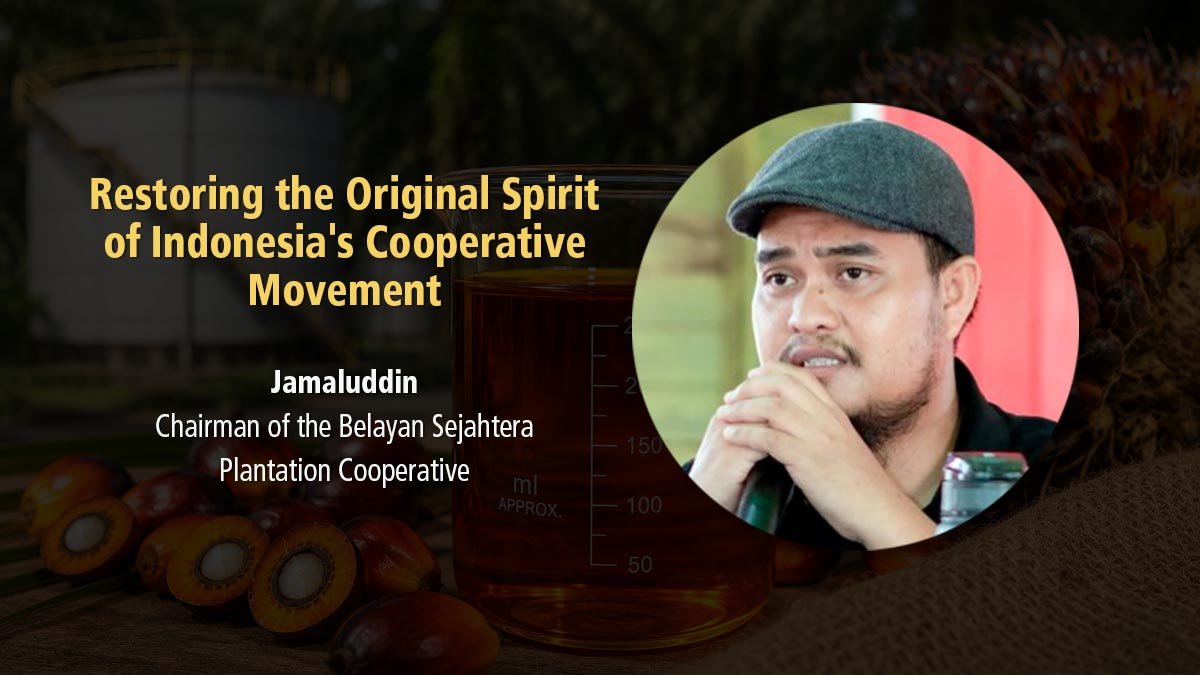
By Jamaluddin, Chairman of the Belayan Sejahtera Plantation Cooperative