Presidential Instruction No. 11/2026 strengthens enforcement against land clearing by fire and restricts the use of traditional practices to tightly defined small-scale, subsistence activities.
PALMOILMAGAZINE, JAKARTA — Indonesia has tightened enforcement of its ban on land clearing by fire under Presidential Instruction (Inpres) No. 11 of 2026, introducing stricter controls on the use of traditional burning practices while requiring greater adoption of fire-free land preparation methods.
The instruction, titled Strengthening Enforcement of the Prohibition on Land Clearing by Burning and Control of Forest and Land Fires, is aimed at strengthening prevention and response measures for forest and land fires, clarifying the legal boundaries of traditional practices and expanding access to alternatives for land preparation without fire.
Under the policy, central and local governments are instructed to coordinate enforcement measures aimed at preventing hotspots, fires and forest and land fires originating from land preparation and cultivation activities.
The government also prohibits the issuance of local policies, regulations, permits, approvals or discretionary decisions that could create or be interpreted as legalizing forest or land burning where such measures conflict with higher-level laws.
Indonesia’s existing environmental framework already prohibits land clearing by burning. Article 69 of Law No. 32/2009, for example, explicitly prohibits land clearing through burning.
Also Read: GAPKI Backs Inpres 11/2026, Calls for Stronger Collaboration to Prevent Forest and Land Fires
Traditional Practices Subject to Strict Conditions
The new instruction does not eliminate all forms of traditional land-clearing practices involving fire. Instead, it places strict conditions on when such practices may be recognized.
The exception is limited to customary practices that have genuinely been carried out from generation to generation, with the communities practicing them clearly identified and verified.
Also Read: Indonesia Palm Oil Companies Strengthen Fire Prevention Ahead of 2026 Dry Season
Land cleared under the mechanism is limited to a maximum of 2 hectares per household and may only be used to grow local food varieties for non-commercial, subsistence purposes.
Communities must also establish firebreaks around the area to prevent flames from spreading or jumping beyond the designated site.
The practice is prohibited on peatlands, in designated buffer zones within a 500-meter radius, protected areas and riverbanks.
Also Read: West Kalimantan Wildfires Recur, Link-AR Borneo Calls for Review of Palm Oil Expansion
Importantly for the plantation industry, the traditional-practice exception does not apply to corporations, commercial plantations, mining activities or holders of business permits, concessions or land rights.
The activity must also not cause air pollution, disrupt public health or transportation, or allow fires to spread to land belonging to other parties.
Land clearing under the traditional-practice provision can only take place after a recommendation from the central and/or local government and with assistance from local authorities. The exception does not apply within forest areas and cannot be expanded beyond the limits established by law.
Also Read: Malaysia CPO Futures Gain, January–February 2027 Contracts Come Under Pressure
Plantation Companies Cannot Rely on Traditional Practices
For the agricultural and plantation sectors, the instruction places particular responsibilities on the Minister of Agriculture.
The government has directed the ministry to formulate and facilitate a national program promoting land opening, preparation and cultivation without fire.
Also Read: PTPN IV PalmCo Accelerates Smallholder Replanting as Partnership PSR Reaches 27,000 Hectares
The program is also expected to provide technology assistance, soil-management equipment, biological decomposers and agricultural machinery to farmer groups and local communities.
At the same time, the Agriculture Ministry is tasked with conducting compliance audits of fire-mitigation infrastructure operated by plantation business permit holders.
The instruction makes clear that traditional practices cannot be used by plantation corporations or industrial-scale businesses as a justification for land clearing by fire.
Also Read: North Sumatra FFB Prices Rise by IDR 22.77/Kg, Highest at IDR 4,079.09
The provision has particular relevance to Indonesia’s palm oil industry, where plantation companies are required to incorporate fire-prevention and mitigation measures into land management. The policy shifts greater emphasis toward prevention during land preparation rather than relying solely on firefighting after fires occur.
Concession Holders Required to Strengthen Fire Prevention
The government is also strengthening obligations for holders of business permits, approvals and land rights.
They are required to actively participate in the prevention, mitigation and control of forest and land fires within their areas of responsibility.
Also Read: Sawit Watch Questions 20-Year Requirement in Forest Community Protection Circular
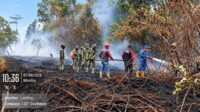
In the forestry sector, permit holders and area managers are required to provide fire-prevention infrastructure, including excavators, certified forest-firefighting teams, observation towers and adequate early-warning systems.
The Minister of Environment and head of the Environmental Control Agency is also tasked with strengthening monitoring of greenhouse-gas emissions, air quality, hotspot distribution and burned areas.
Concession and land-right holders are additionally required to protect their areas and maintain surrounding buffer zones against fire threats, including an area extending at least 5 kilometers from the outer boundary of their land parcels.
Also Read: Forest Fire Near PT Jalin Vaneo Plantation Prompts Manggala Agni Response in Kayong Utara
Administrative Sanctions and Environmental Recovery Claims
Enforcement under the policy extends beyond prevention requirements.
The instruction directs authorities to impose administrative sanctions on business entities that fail to meet their forest and land-fire prevention obligations.
Also Read: The Missing Link in Indonesia’s Palm Oil Traceability
Potential measures include written warnings, government coercive action, administrative fines, suspension of environmental permits and revocation of environmental permits, subject to the relevant authorities’ powers.
The government may also pursue civil claims for environmental recovery costs and apply the principle of strict liability to parties held responsible for fires.
The policy reinforces Indonesia’s broader shift toward fire-free land preparation as the primary approach, while placing the use of fire under traditional practices within a narrowly defined legal exception.
For plantation companies, including palm oil producers, the instruction further emphasizes the need to maintain adequate fire-prevention systems throughout land preparation and plantation management and prevents commercial operators from invoking traditional practices as a basis for land clearing by burning. (P2)