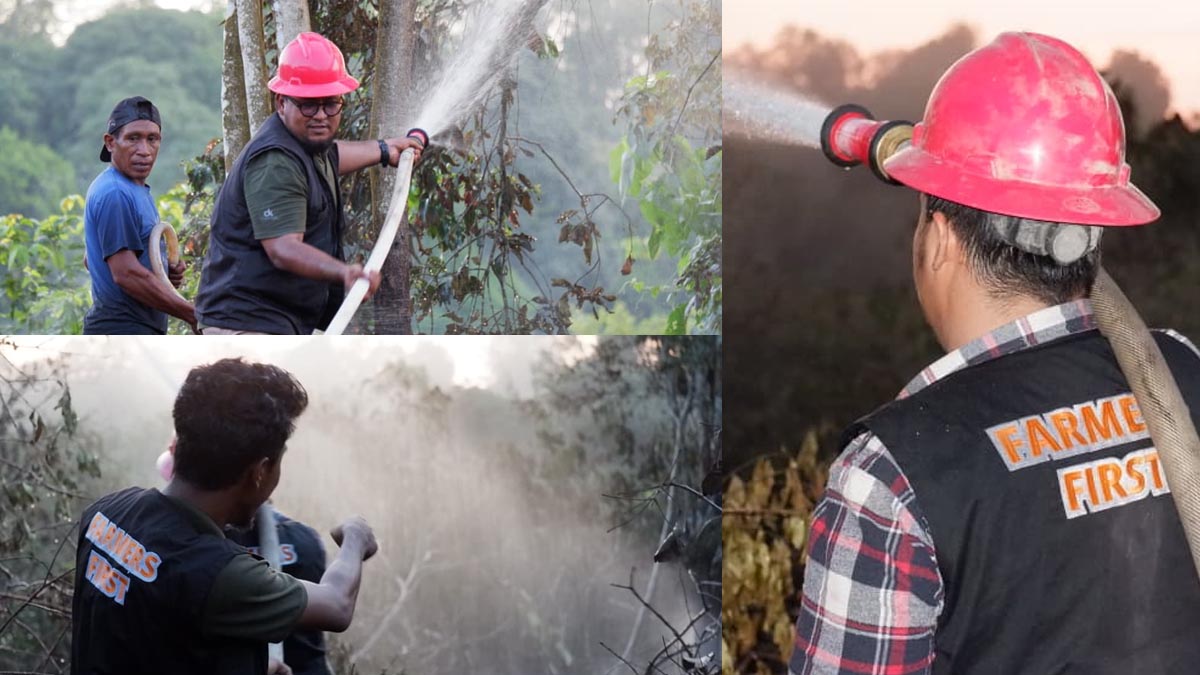
Independent palm oil farmers across Sumatra and Kalimantan are strengthening fire patrols, emergency response teams and peatland monitoring as Indonesia faces an increasingly severe dry season in 2026.
PALMOILMAGAZINE, JAKARTA — Independent palm oil smallholders across Indonesia are stepping up fire patrols and emergency response efforts as prolonged dry conditions raise the risk of land and forest fires spreading into plantations.
Since early 2026, weather forecasters and environmental observers have warned that Indonesia could face an unusually dry year, with the potential influence of a strong El Niño event. By September, when rainfall would normally begin returning to several regions, many areas were still experiencing dry conditions, leaving agricultural land, plantations and forests increasingly vulnerable to fire.
Also Read: FORTASBI Warns Palm Smallholders to Brace for Early 2026 Dry Season
Data from the Indonesian Sustainable Palm Oil Independent Farmers Forum (FORTASBI) show the scale of the deterioration. During January-March 2026, about 67,450 hectares of land were recorded as affected by fires. By Aug. 20, the indicative cumulative area had surged to 667,133 hectares.
The increase was particularly sharp in August. Some 465,174 hectares of burned area were recorded during the first 20 days of the month alone, meaning nearly 70% of the year’s cumulative burned area had occurred in less than three weeks.
The worsening situation has put independent smallholders to the test, particularly farmers managing oil palm plantations on peatland, where dry conditions can make fires difficult to contain and allow them to spread underground.
Also Read: FORTASBI Highlights Independent Smallholders’ Role in Emissions Reduction and Forest Conservation
Rather than focusing solely on protecting their own plantations, a number of certified independent smallholder groups under the Indonesian Sustainable Palm Oil (ISPO) and Roundtable on Sustainable Palm Oil (RSPO) schemes have also mobilized to help communities outside their immediate areas.
Farmers Join Firefighting Efforts
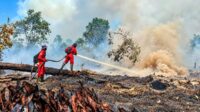
In Tebo, Jambi, the Bangun Seranten Independent Smallholder Farmers Association (PPS-BS) deployed its fire brigade to Pintas Tuo village during the first week of September.
The fire was located about 25 kilometers from members’ plantations and burned land belonging to farmers outside the association. Nevertheless, PPS-BS members joined local residents in fighting the blaze for two days and two nights using the equipment available to them.
Also Read: When Smallholders Support Global Palm Oil Markets, It Is Time to Rethink Farm Scale
Their objective was not only to extinguish the existing fire but also to prevent it from spreading across a wider agricultural and plantation landscape.
A similar response took place in Siak, Riau, where the Internal Control System (ICS) team of Beringin Jaya Cooperative traveled to Dayun village after receiving reports of a peatland fire near Zamrud National Park.
Fighting fires on peatland presents particular challenges. The cooperative team joined Manggala Agni firefighters and local residents to control a fire that had been burning since late August.
Also Read: RSPO Calls for Coordinated Response to Indonesia Fires to Protect Communities and Wildlife
Although the fire was about 30 kilometers from members’ plantations, the cooperative considered the risk of the flames spreading across dry peat significant enough to warrant intervention.
At the same time, Beringin Jaya’s farmers and cooperative officials continued monitoring peat moisture levels in their own plantations. Water was also injected into areas showing signs of drying to reduce the risk of ignition.
Building Permanent Fire-Response Systems
In East Kalimantan, Belayan Sejahtera Cooperative in Kutai Kartanegara has taken a more structural approach by establishing a Fire-Aware Farmer Group, known locally as Kelompok Tani Peduli Api (KTPA).
The unit is designed as an emergency response mechanism for protecting members’ plantations while also assisting neighboring farmers when fires occur. It also provides training on fire monitoring and regular patrols.
Also Read: Desacralizing Local Wisdom to Mitigate Forest and Land Fires
Similar preventive measures have been adopted by other ISPO- and RSPO-certified farmer groups in several regions.
In Central Kalimantan’s Kotawaringin Barat, the Independent Palm Oil Farmers Association (APKSM) conducted regular plantation patrols throughout August and September to identify potential fire hotspots before they could develop into larger fires.
“If fire enters our plantations, it threatens our livelihoods. We are paying close attention to the situation, and our ICS fire-control team remains on standby,” Widodo, chairman of APKSM’s ICS, said in a statement received by PalmOilMagazine on Sept. 24.
Jamaluddin, chairman of Belayan Sejahtera Cooperative, said the cooperative’s commitment extends beyond its own members.
“We are committed to keeping our land and the land of surrounding farmers safe, in line with sustainable palm oil standards,” he said.
Cooperation Beyond Plantation Boundaries
Collaboration with neighboring companies has also become part of the preparedness strategy.
In Merangin, Jambi, Tanjung Sehati Lestari Cooperative worked with a nearby company to conduct emergency land-fire response training on Sept. 9.
Also Read: CPO KPBN Inacom Rises to IDR 15,075/kg on Monday (Sept. 28), Malaysian Palm Oil Futures Fall
“The training was a rapid step to ensure that all ICS managers have a well-prepared emergency response plan. We are grateful for the company’s support in strengthening this preparedness because fire does not recognize plantation boundaries,” cooperative chairman Jalal Sayuti said.
The actions taken by these smallholder groups highlight a broader shift in how fire prevention is being approached at the plantation level.
For farmers operating with limited resources, fire preparedness is not simply an environmental obligation. It is directly linked to protecting plantations, household incomes and the wider rural economy.
Also Read: The Agrarian Reform Law and Investment Prospects of Palm Oil
As dry conditions intensify, their experience also demonstrates the importance of early detection, community-based patrols and cooperation across property boundaries. For independent smallholders, preventing a fire from becoming a wider disaster often begins with acting before the flames reach their own plantations. (P3)