PTPN IV PalmCo is strengthening partnerships with smallholder farmers through PSR Award 2026, while the government calls for faster implementation of replanting schemes to improve productivity and sustainability.
PALMOILMAGAZINE, YOGYAKARTA — PT Perkebunan Nusantara (PTPN) IV PalmCo is strengthening its partnerships with Indonesian smallholder palm oil farmers as the company seeks to accelerate the Smallholder Palm Oil Replanting or Peremajaan Sawit Rakyat (PSR) program and improve plantation productivity.
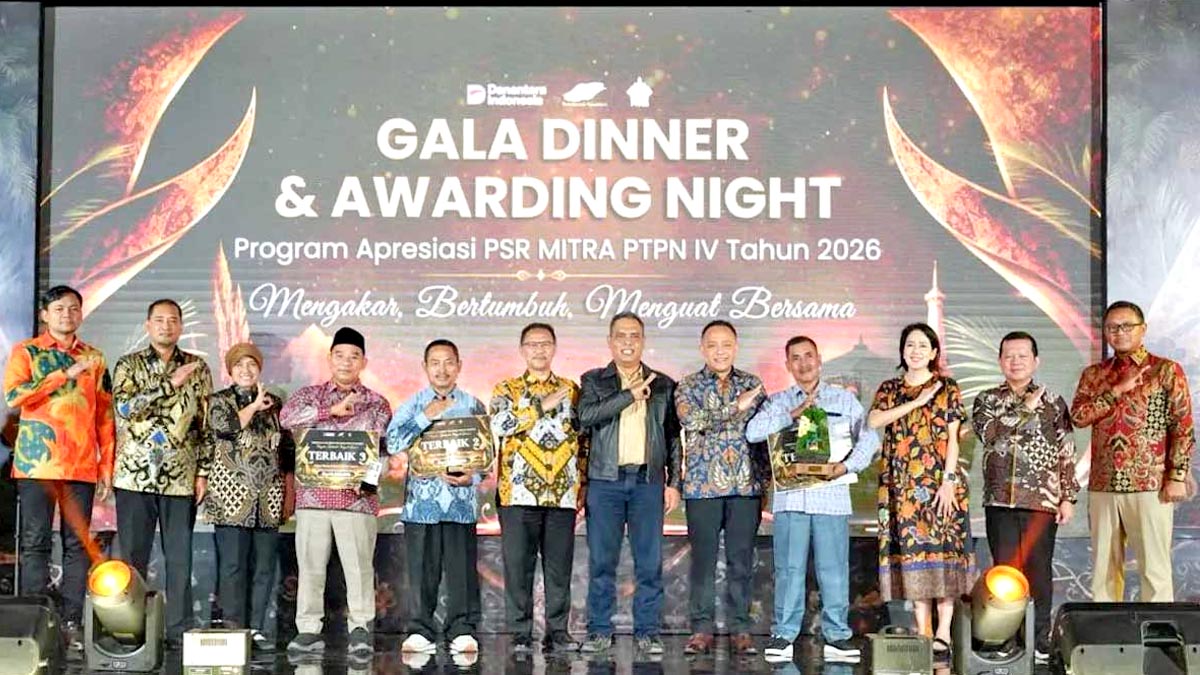
According to a report by Antara on Sunday (September 13, 2026). The company launched the PSR Award 2026, its first such initiative, as part of efforts to recognize farmers, cooperatives, regional operations and supply-chain partners contributing to the development of a more productive and sustainable smallholder palm oil ecosystem.
Also Read: PTPN IV PalmCo Profit Jumps 54% to IDR 3.23 Trillion in H1 2026 on Higher CPO Prices
PTPN IV PalmCo President Director Jatmiko K. Santosa said partnerships with smallholders are fundamental to the company’s long-term operations.
“We reaffirm our commitment to growing together with smallholder palm oil farmers through partnerships that are transparent, productive, mutually beneficial and sustainable,” Jatmiko said at the Gala Dinner and PSR Award 2026 in Yogyakarta.
The awards recognize farmers, cooperatives, regional operations, TBS purchasing units and fresh fruit bunch (FFB) suppliers considered to have made significant contributions to PalmCo’s partnership ecosystem.
Also Read: PalmCo Leverages AI Technology to Transform Palm Oil Management with Data-Driven Decisions
Smallholders a Strategic Pillar of Indonesia’s Palm Oil Industry
PTPN IV PalmCo President Commissioner Desrial said smallholders occupy a significant position in Indonesia’s palm oil industry, accounting for around 41%-42% of the country’s palm oil plantation area.
The scale of the smallholder sector makes it a strategic component of the industry’s long-term sustainability, he said.
Also Read: PTPN IV PalmCo and ITS Launch Five-Year Partnership to Develop Palm-Based Green Fuel
PalmCo therefore sees stronger links between the upstream and downstream sectors as an important part of building a more integrated and efficient palm oil value chain.
The company is also promoting a circular-economy approach by strengthening connections across different parts of the palm oil business, with the aim of improving efficiency and sustainability throughout the value chain.
Setiyono, chairman of the Indonesian Association of Oil Palm Farmers under Nucleus Estate Schemes (ASPEKPIR), welcomed PalmCo’s efforts to strengthen relations with smallholders.
Also Read: KPBN Inacom CPO Tender Withdrawn on September 14, Highest Bid at IDR 15,700/Kg
He said the PSR program would be critical to the future of smallholder farmers. Its success should not be measured solely by the number of old trees replaced, but also by improvements in plantation productivity and the welfare of farming households.
Strengthening farmer institutions and ensuring the long-term sustainability of smallholder plantations for future generations are also essential components of a successful replanting program, he said.
Five Performance Indicators for PSR Award
PalmCo designed the PSR Award 2026 around five award categories, each based on measurable and transparent performance indicators.
The Best Plasma Plantation category assesses plantation productivity and the implementation of a single-management system.
Also Read: Malaysia CPO Futures Gain, January–February 2027 Contracts Come Under Pressure
The Best PSR Regional category considers the composition of partnerships, achievement against the company’s annual work and budget plan (RKAP), realized plantation area and the proportion of PSR area relative to PTPN IV PalmCo’s total area.
The Best FFB Purchasing Region category is assessed based on FFB volume against the RKAP target, contribution margin against the RKAP and the proportion of FFB supplied to PalmCo.
The Best FFB Purchasing Unit category considers RKAP achievement, contribution margin and the percentage of FFB supplied to the relevant regional operation.
Also Read: North Sumatra FFB Prices Rise by IDR 22.77/Kg, Highest at IDR 4,079.09
Meanwhile, the Best FFB Supplier category takes into account supply volume, consistency, FFB quality, legality and administrative compliance.
The criteria indicate that the inaugural award is not focused solely on supply volumes. Productivity, quality, compliance, consistency and partnership governance also form part of the assessment.
Partnership Route PSR Still Needs to Accelerate
The Indonesian government has also called for faster implementation of the PSR program through partnership schemes.
Heru Tri Widarto, Director General of Plantations at the Ministry of Agriculture, said the national PSR program has progressed since it was launched in 2016.
Also Read: East Kutai Accelerates Palm Oil Replanting, 1,900 Hectares Target ISPO Certification
The Directorate General of Plantations has so far issued technical recommendations, known as Rekomtek, covering around 440,000 hectares under the PSR program.
However, PSR implementation through the partnership route remains at around 27,000 hectares, indicating that greater coordination is needed among the government, PTPN, farmers and strategic partners.
Heru urged PTPN IV PalmCo and other stakeholders to strengthen engagement with plasma farmers while accelerating the issuance of Rekomtek.
Faster implementation is needed to replace aging oil palm trees with high-yielding planting material and improve plantation management practices. The objective is to raise both FFB productivity and quality among smallholders.
Stronger company-farmer partnerships will therefore be important in ensuring that replanting delivers more than tree replacement. The broader objective is to develop smallholder plantations that are more productive, competitive and sustainable over the long term. (P2)