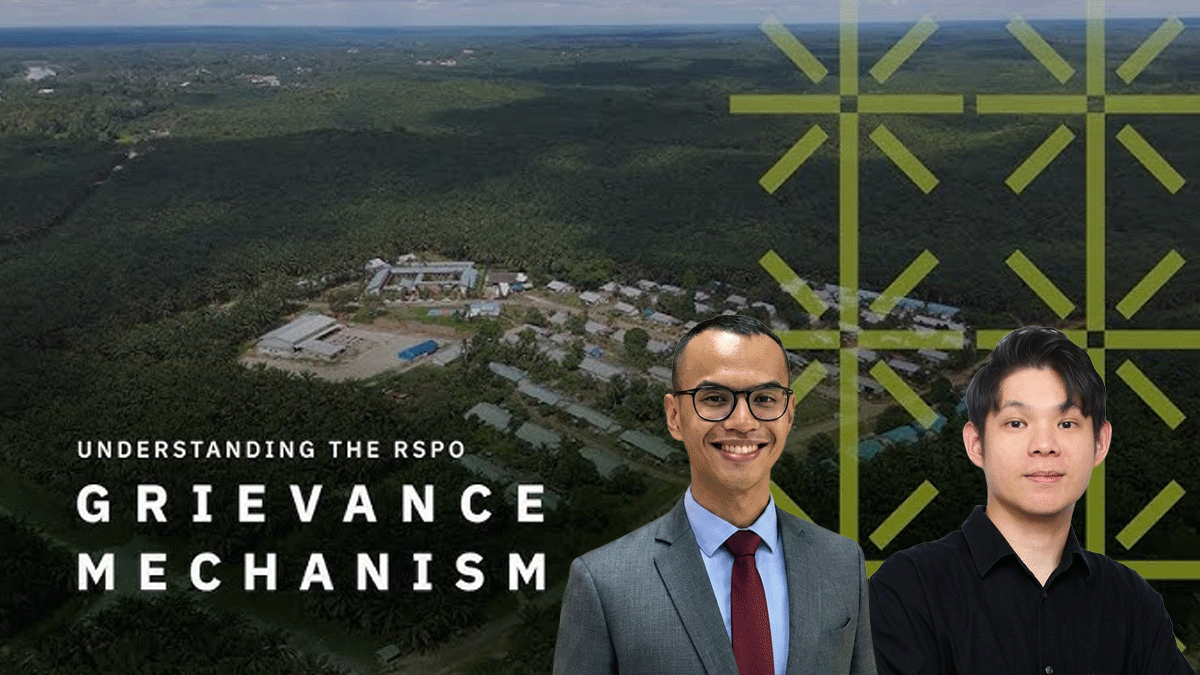
PALMOILMAGAZINE, JAKARTA – The RSPO Dispute Settlement Facility (DSF) mediation is one of the alternative dispute resolution mechanisms available under the RSPO Complaints System. Find out what’s behind this unique process, and how collaborative solutions are an effective method of amicably resolving disagreements between stakeholders and RSPO Members.
In the palm oil industry, differing interests between companies, workers, communities, and other stakeholders may often lead to conflict. If handled effectively, these conflicts present opportunities for constructive resolution and positive outcomes. The Roundtable on Sustainable Palm Oil (RSPO) offers a way to turn these conflicts into opportunities through mediation.
RSPO is a global, non-profit organisation with a voluntary membership base. It brings together stakeholders from all across the palm oil value chain to develop and implement global standards for sustainable palm oil. One of the checks and balances in RSPO is the RSPO Complaints System – a fair, transparent and impartial process to duly handle and address complaints against RSPO Members.
Also Read: APKSM Strengthens Smallholder Readiness for ISPO and RSPO Certification in West Kotawaringin
Activating the DSF process
When a Complaint is formally accepted under the RSPO Complaints System, disputing parties (the Complainant and the RSPO Member) are advised on the option of DSF mediation. In order to activate the DSF mediation process, both parties must mutually agree to undertake mediation. From there, DSF mediators will be introduced separately to both parties and they are given the opportunity to mutually select a preferred DSF mediator. The selected DSF mediator will then take the lead and facilitate the process towards exploring an amicable resolution.
The objective of DSF mediation is to help stakeholders and RSPO Members work together towards reaching a mutually satisfactory resolution, facilitated by a qualified professional mediator. RSPO’s DSF mediation process is founded on three pillars: voluntary participation, confidentiality, and independence and impartiality. Participation is entirely voluntary, with parties having control over their involvement and the outcomes, including the right to withdraw at any time. The process is strictly confidential, ensuring that information shared during mediation is not disclosed without consent. DSF mediation is also independent and impartial, where the professional mediator will facilitate dialogues without imposing judgments. This provides a safe space for parties to speak freely and to be heard.
In the process of DSF mediation, the professional mediator will guide the parties in identifying a common ground between them and determining the root cause of their disagreements. The mediator’s expertise helps the parties focus on exploring an amicable resolution that actually addresses those root causes, one by one. Any resolution achieved is then bound in good faith through a mutual agreement signed by both parties.
Also Read: RSPO Tightens 2026 Shared Responsibility Rules to Accelerate CSPO Adoption
Collaborative solutions
Even in the presence of a mediator, however, it is the parties’ duty to actively collaborate with one another and come up with solutions to solve their issues.
Hyang I. Mihardja, one of the professional mediators providing mediation services under the DSF, says “Mediation requires the parties to understand the true spirit of mediation, to deliver justice without disregarding the values of utility. Ultimately, this leads to the establishment of good relationships and the co-creation environment of productive business sustainability, in harmony with a decent standard of living for the community. Without this awareness, even well-intended resources may fail to serve their purpose.”
Also Read: Indonesia Warns Palm Oil Mills Over FFB Underpricing, Threatens License Revocations
Essentially, DSF mediation works best when Parties participate in the mediation process in good faith, with the common goal of achieving an amicable resolution. It is also important that the decision makers of the parties are involved in the mediation process.
Hyang also calls upon stakeholders to always be aware of the human side of mediation, saying, “Mediation is not just a procedure. It deals with people and human dignity – one that calls for empathy and responsibility.”
As opposed to a rigid adjudication process, as we might see in courts, RSPO’s DSF mediation process provides flexibility and gives room for parties to empathise with one another and collaborate to come up with methods and solutions that best suit their needs and interests. Through continuous and mediated dialogues, parties can gradually build trust and become more open to each other. And the channel of communication remains open between the parties even after the conclusion of mediation, which is just as important.
Rahmat Nugraha, senior HR Manager of PT Agro Kati Lama, a subsidiary of SIPEF Group (an RSPO Member), was involved in a mediation process under RSPO’s DSF and achieved an amicable resolution. Pak Rahmat shared that “The professional and facilitative approach of the mediation process between PT Agro Kati Lama (PT AKL) and the Serikat Buruh Sawit Sejahtera (SBSS)/Sawit Watch enabled both parties to engage in open discussions, better understand each other’s perspectives, and work towards a jointly agreed solution through consensus. This experience demonstrates that independent, dialogue-based dispute resolution can effectively address complex issues in a fair and sustainable manner”.
Experience from local community engagement
What makes the RSPO’s DSF unique is that it is supported by a panel of advisers (the “DSF Advisers”). While not involved directly in mediation sessions between parties, the DSF Advisers contribute to the mediators’ expertise by sharing hands-on experience from their engagement with local communities, civil society, the palm oil industry, and dispute resolution forums. The DSF Advisers take the lead in evaluating insights and lessons learned from emerging trends in oil palm disputes, which then increase the capacity of the RSPO’s registered DSF mediators. The DSF Advisers serve an important role in the continuous improvement of the quality of mediation services provided to RSPO stakeholders.
Also Read: Bappenas Pushes IPB to Become Hub of Palm Oil Innovation and Downstream Development
Paul Wolvekamp is the current Chair of the DSF Advisers. He once held the position of Deputy Director of Both ENDS, an environmental justice NGO based in the Netherlands, where he continues to work to this day. He shares with us his thoughts on why access to the RSPO’s DSF is so important in the palm oil industry in Indonesia. “The RSPO Dispute Settlement Facility (DSF) serves as an important bridge between companies and communities in Indonesia,” Paul says. “It provides a neutral, fair, and trusted space where conflicts can be discussed openly and resolved through cooperation rather than confrontation. By promoting dialogue, transparency, and mutual respect, it helps rebuild trust and restore relationships between neighbours and key stakeholders working toward sustainable palm oil production.”
Paul also believes that social, land and environmental matters are especially important issues to resolve within Indonesian communities. “In Indonesia’s diverse and vibrant economy – where livelihoods, culture, and the environment are closely connected – peaceful and constructive dispute resolution is essential,” Paul says. “It is also a reality that Indonesia harbours many palm oil-related unresolved land conflicts. In this context, DSF not only addresses complaints, but also helps both companies and communities better understand and navigate complex land tenure and rights issues, including legal processes and customary claims.”
Paul also shared that mediation through the RSPO DSF helps support both businesses and communities. “The DSF also encourages dialogue within and between communities to build consensus,” Paul continues. “Through mediation, assisted by qualified impartial mediators and a shared commitment to sustainability, it supports responsible business practices and allows a voice to local stakeholders to protect community rights, cultural values, and the environment – helping ensure inclusive and sustainable growth for all. RSPO DSF, while unavoidably meeting many challenges, offers proof of concept and sets a positive precedent for other commodity supply chains.”
Also Read: SPKS Welcomes 80% Plasma Plan, Urges Stronger Land Reform and Oversight
Financial support for stakeholders
To ensure that financial constraints do not prevent participation, the RSPO DSF also provides financial assistance to eligible stakeholders. This support not only removes barriers for less financially equipped parties but also allows parties to co-own the mediation process. Parties who wish to apply for Financial Assistance can submit a request via email to the RSPO Secretariat, where eligibility will be reviewed and processed accordingly.
Robiyansih is the Chair of the Serikat Buruh Sawit Sejahtera (SBSS), an Indonesian labour union whose members consist of workers in the palm oil industry. His union, aided by an NGO, Sawit Watch, utilised the RSPO’s DSF mediation process with financial assistance provided by RSPO to resolve a dispute with an RSPO Member (PT AKL). “We have experienced significant benefits from DSF mediation regarding the issues we faced,” Robiyansih shares. “We have the legal authority to enforce the agreements between the two parties and can urge the company to implement our demands on the ground.”
Also Read: One-Gate Export System and a New House Called Danantara
Robiyansih also offers his perspective on the importance of DSF mediation for labour unions. “The DSF must be developed for labour unions facing internal company issues. I believe DSF (mediation) discussions must be cultivated and, based on our experience, are very engaging,” Robiyansih continues. “DSF should be used to re-discuss what labour unions have previously agreed to (with a company), so that the company we are complaining about actually implements the regulations in force on the field.”
Robiyansih proceeds to inform us of his opinion regarding the financial assistance provided by the RSPO in accessing DSF mediation. “Financial assistance from RSPO greatly assists the struggle of independent labour unions, as experienced by our union, SBSS, which selected mediation through the DSF, at a time when our union had not implemented the collection of member contributions, especially since we were still a PUK (a company-level labour union)”, Robiyansih informs us. “RSPO’s financial assistance is greatly needed by labour unions facing issues and lodging complaints through the RSPO DSF, to assist and facilitate access to mediation.”
Hotler “Zidane” Parsaoran, was the lead representative from Sawit Watch in assisting Robiyansih during the mediation process between SBSS and the RSPO Member (PT AKL). “The RSPO offers several options for resolving complaints, one of which is Dispute Settlement Facility (DSF) mediation,” Zidane says. “This option facilitates the parties’ dispute resolution through the presence of a mediator.”
Also Read: Indonesia Sets June CPO Reference Price at USD 1,029.51/MT Amid Softer Global Demand
Zidane also shares his views on the parties’ liberty to select a mediator provided by the RSPO DSF. “The parties are given the opportunity to agree on a mediator who they believe is capable of mediating, has integrity, understands the complaint, and is able to effectively facilitate the negotiation process, ultimately reaching an agreement on resolving the complaint. Complainants can choose to use DSF mediation from the outset when deciding to lodge a complaint with the RSPO.”
Additionally, Zidane shares his personal experience with RSPO financial assistance. “The negotiation process certainly requires resources, but DSF mediation also provides financial assistance to those in need. This assistance is accessible, the process is simple, and can be done quickly.”
In summary, mediation through the RSPO’s DSF is an effective method of amicably resolving disagreements between stakeholders and RSPO Members. Parties are able to freely engage in constructive dialogues and structure-guided processes, while being aided by a qualified professional mediator. Through DSF mediation, stakeholders and RSPO Members can achieve sustainable solutions to various dynamics in the palm oil industry.
By: M. Reza Haryo Wibowo and Lee See Lung
For more information, please visit: https://rspo.org/who-we-are/complaints/dispute-settlement-facility/
Or please contact the RSPO Secretariat’s Grievance Unit at:
About the authors:
Reza Haryo Wibowo is the RSPO Manager, Grievance (Indonesia)
Lee See Lung is the RSPO Assistant Manager, Grievance