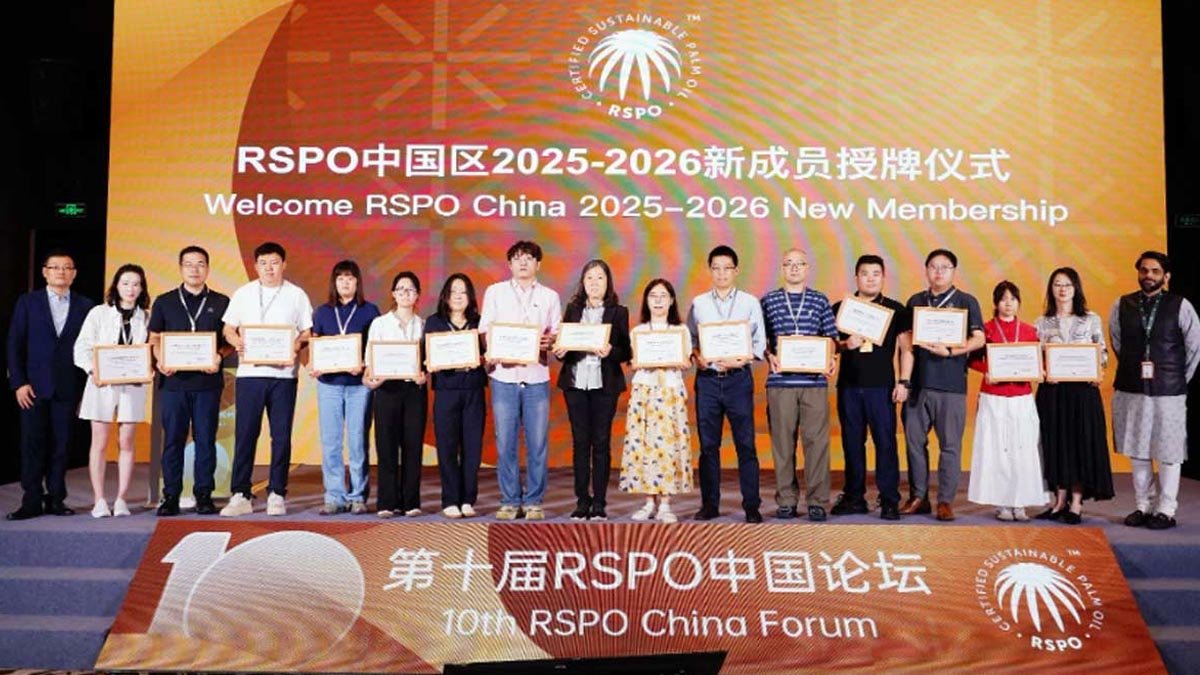
PALMOILMAGAZINE, SHANGHAI – China is reinforcing its role as one of the world’s most strategic markets for sustainable palm oil, driven by an ambitious green development agenda under its 15th Five-Year Plan, which began in 2026. The country’s latest policy initiatives are accelerating the adoption of sustainable commodity supply chains, including certified sustainable palm oil (CSPO).
According to information published by the Roundtable on Sustainable Palm Oil (RSPO), these developments were highlighted during the 10th RSPO China Forum, held in Shanghai on July 3, 2026. The event also marked more than a decade of RSPO’s efforts to promote sustainable palm oil market transformation across China.
RSPO Chief Executive Officer Joseph D’Cruz said China is entering a pivotal stage in its transition toward a greener economy. As one of the world’s largest palm oil consumers, he noted, the country’s procurement and sourcing decisions will play a critical role in shaping the future of sustainable global supply chains.
Also Read: RSPO Tightens 2026 Shared Responsibility Rules to Accelerate CSPO Adoption
“RSPO remains committed to strengthening collaboration in China by expanding industry engagement, integrating sustainability into procurement and investment decisions, fostering strategic partnerships, and supporting members as they navigate evolving regulations and market expectations,” D’Cruz said.
The momentum is supported by several major policy initiatives introduced by the Chinese government in 2026. Under the theme “Beautiful China,” the 15th Five-Year Plan places environmental sustainability at the center of national development. Authorities have also enacted the Ecological Environment Code, providing a stronger legal framework for environmental protection, while introducing the Green Finance-Supported Project Catalogue, which expands access to green financing across the entire palm oil value chain—from production and trade to downstream consumption.
Opening the forum, Xu Yingming, Director of the Chinese Academy of International Trade and Economic Cooperation under China’s Ministry of Commerce, emphasized that green trade cooperation has become an essential instrument for addressing climate change while enhancing the country’s economic competitiveness.
He added that strengthening sustainable trade not only supports high-quality economic growth but also reinforces China’s position in an international trading system that increasingly prioritizes environmental and sustainability standards.
Also Read: RSPO Strengthens Smallholder Support with IDR416 Billion Amid Stricter Global Sustainability Rules
Certified Sustainable Palm Oil Consumption Continues to Rise
RSPO reported significant progress in China over the past decade. As of 2026, the country is home to more than 540 RSPO members, supported by 510 certified supply chain facilities, reflecting growing industry participation in sustainable sourcing.
The expansion has translated into stronger demand for Certified Sustainable Palm Oil (CSPO). In 2024, China’s consumption of CSPO reached approximately 550,000 metric tons, representing nearly 12% of the nation’s total palm oil consumption—a notable milestone given the scale of China’s market.
Also Read: RSPO–FONAP Reciprocal Membership Marks New Phase of Sustainable Palm Oil Collaboration in Europe
RSPO has also broadened its cross-sector partnerships. During the RT2025 conference held in November 2025, the organization signed a memorandum of understanding with Nanjing Hongshan Forest Zoo to promote biodiversity conservation while raising public awareness of sustainable palm oil.
According to Lifeng Fang, RSPO’s Head of China Market Transformation, China’s leadership in responsible sourcing and sustainable consumption will increasingly shape the future growth of the certified palm oil market and strengthen the resilience of global supply chains.
Also Read: Airlangga: Research and Downstream Innovation Will Shape the Future of Indonesia’s Palm Oil Industry
Sustainable Palm Oil Supports China’s Climate Goals
Speaking at the forum, Elaine Chan, Head of Climate Change and Reporting (Group Sustainability) at SD Guthrie, highlighted sustainable palm oil as a key contributor to China’s ambition of reaching peak carbon emissions by 2030.
She introduced SD Guthrie’s “Beyond Zero” framework, which integrates climate change mitigation, biodiversity conservation, regenerative agriculture, and supply chain transparency to accelerate the transition toward a low-carbon economy.
Through the 10th RSPO China Forum, RSPO aims to deepen collaboration among its members, industry stakeholders, investors, and policymakers in China to develop practical solutions that accelerate the transformation of the sustainable palm oil sector while supporting the country’s broader green development agenda amid an evolving global marketplace. (P2)