

Indonesia’s palm oil outlook for 2026 remains relatively firm, supported by biodiesel-driven domestic demand, resilient exports and CPO prices projected at up to US$1,172 per ton.
PALMOILMAGAZINE, BOGOR — Indonesia’s palm oil industry is entering 2026 with a relatively positive outlook, although its performance will depend not only on production growth but also on CPO prices, domestic consumption, exports and the continued implementation of the national biodiesel program.
According to the 2026 Palm Oil Commodity Outlook, CPO prices are projected to remain at relatively strong levels next year, with scenarios ranging from US$959 to US$1,172 per ton.
Rizki Amalia of the Palm Oil Research Center (PPKS), PT Riset Perkebunan Nusantara, presented the projections in the 2026 Plantation Commodity Outlook. The three price scenarios put CPO at US$959, US$1,066 and US$1,172 per ton, respectively.
Also Read: KPBN CPO Price Falls to IDR 15,957/kg on Tuesday (Sept. 8), Malaysia Futures Near RM5,000
For comparison, the actual CPO price in 2024 was recorded at US$942 per ton, while the 2025 projection stood at US$1,017 per ton.
The range of projections highlights the continued sensitivity of palm oil prices to global market developments and underlying supply-and-demand fundamentals.
B40 Supports Palm Oil Outlook
One of the key factors shaping the 2026 outlook is the implementation of Indonesia’s biodiesel program.
The 2026 outlook identifies the B40 program as one of the factors influencing CPO price projections. Other variables include economic recovery in importing countries, production of competing vegetable oils in major producing nations and import tariff policies implemented by major buying countries.
Also Read: Malaysia CPO Futures Rise for Third Session, November Contract Nears RM5,000
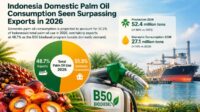
Biodiesel is also becoming increasingly important to Indonesia’s domestic palm oil consumption structure.
Data presented in the outlook show that biodiesel consumption grew at an average rate of around 12.2% annually between 2020 and 2024.
By 2025, Indonesia’s installed biodiesel production capacity had reached 19.15 million kiloliters, supported by 26 biodiesel plants.
Also Read: Indonesia Eyes Green Technology to Transform Palm Oil Downstreaming
As more palm oil is allocated to the energy sector, biodiesel could become a major pillar of domestic demand while helping maintain balance in the palm oil market.
However, the program also faces several challenges. The outlook highlights the sustainability and availability of feedstock, price differentials between crude oil and vegetable oils, the adequacy of biodiesel subsidies and domestic biodiesel production capacity as issues that require continued attention.
Domestic Consumption and Exports Strengthen
Beyond biodiesel, domestic consumption and exports remain important drivers of Indonesia’s palm oil industry.
Through July 2025, domestic palm oil consumption reached 14.3 million tons, up 6.57% from the same period. Exports stood at 19.2 million tons, representing growth of 11.1%.
In trade terms, Indonesia’s palm oil export value through July 2025 reached approximately IDR 343.7 trillion, underscoring the commodity’s significant contribution to the national economy.
The strong market performance provides an important foundation for the industry to maintain its contribution to state revenues while supporting economic activity across major palm oil-producing regions.
Industry Challenges Extend Beyond Prices
Despite relatively positive production and price prospects, Indonesia’s palm oil industry continues to face structural challenges.
The 2026 outlook identifies governance as a key issue. Land legality, the resolution of oil palm plantations located within forest areas, implementation of sustainability standards and governance of smallholder plantations remain areas requiring further improvement.
Also Read: Indonesia’s Non-Oil and Gas Exports Rise 6.84% in July, Vegetable Oils Lead Trade Surplus
Downstream development is another priority.
The industry needs to diversify export markets, increase penetration into emerging markets, strengthen refinery and downstream processing capacity, and expand research and development support.
These measures are essential if Indonesia is to move beyond reliance on exports of raw or semi-processed palm oil and capture greater value from the commodity domestically.
Strengthening Indonesia’s Competitiveness
The 2026 Palm Oil Commodity Outlook also highlights several strategic priorities, including cost leadership to maintain competitive pricing, supply stability, optimization of the CPO Exchange and stronger international palm oil diplomacy.
The industry’s challenge in 2026, therefore, will extend well beyond increasing production.
Indonesia must simultaneously strengthen competitiveness, expand markets, accelerate downstream development, improve smallholder productivity and enhance governance throughout the palm oil supply chain.
Against this backdrop, relatively firm CPO price projections provide room for optimism. Domestic demand from the biodiesel sector continues to expand, while export markets remain an important source of demand.
If productivity improvements can be pursued alongside plantation replanting, downstream expansion, better governance and supportive trade policies, Indonesia’s palm oil industry has an opportunity to maintain its position as one of the country’s strategic commodities in 2026.
Ultimately, the challenge for Indonesia’s palm oil sector is not simply to produce more palm oil, but to transform higher production into greater competitiveness, stronger domestic value addition and broader economic benefits across the entire supply chain, including smallholders. (P2)