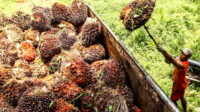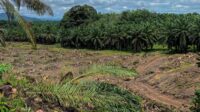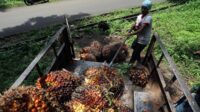
PALMOILMAGAZINE, JAKARTA – Indonesia’s Ministry of Agriculture has moved swiftly to address declining fresh fruit bunch (FFB) prices in several palm oil-producing regions, bringing together industry stakeholders, smallholder associations, and law enforcement agencies to prevent further pressure on farmers and maintain stability in the national palm oil sector.
The response was outlined by Deputy Minister of Agriculture Sudaryono following a coordination meeting attended by representatives from the Indonesian Palm Oil Association (GAPKI), farmer organizations, and the National Police’s Food Task Force.
According to the ministry, the meeting was convened amid growing concerns over falling FFB prices and uncertainty surrounding the government’s planned one-stop export system for natural resources under PT Danantara Sumber Daya Indonesia (DSI). Market participants have cited the policy transition as one of the factors contributing to weaker FFB prices at the farm level.
Also Read: Indonesia Sets June CPO Reference Price at USD 1,029.51/MT Amid Softer Global Demand
Five Measures to Stabilize FFB Prices
During the meeting, the government and industry stakeholders agreed on five key measures aimed at restoring confidence and ensuring a smooth implementation of the new export framework.
First, authorities concluded that the current price volatility is largely driven by market sentiment and uncertainty rather than fundamental supply-and-demand conditions.
“The bottleneck we are seeing today is mainly caused by concerns, uncertainty, and a lack of understanding regarding the new one-stop export mechanism,” Sudaryono said.
Also Read: KPBN CPO Bids Surge 7.7% Despite Withdrawn Tenders, Malaysia Futures End Mixed
Second, the government reiterated that PT DSI will serve as a supervisory and management entity for natural resource exports and will not collect additional fees or take a share of export transaction profits.
“PT DSI will not profit from export transactions and will not impose additional charges. Farmers and exporters should not be concerned because business activities will continue as usual,” Sudaryono emphasized.
Third, the government confirmed a transition period from June 1 to August 31, 2026. During this phase, exports will continue under existing arrangements while stakeholders adapt to the new system. Companies ready to migrate to the new framework may begin doing so from September 1, with full implementation targeted for January 1, 2027.
Also Read: One-Gate Export System and a New House Called Danantara
Fourth, downstream palm oil industries—including refiners, exporters, and processors—will continue operating normally throughout the transition period.
Fifth, stakeholders agreed that FFB purchasing prices should be adjusted to reflect regional crude palm oil (CPO) reference prices to help restore stability at the farmer level.
Ministry Identifies 139 Mills Cutting FFB Prices
Sudaryono revealed that the Ministry of Agriculture has identified 139 palm oil mills across Indonesia that lowered their FFB purchase prices in recent weeks.
The ministry has urged these companies to immediately realign buying prices with prevailing regional CPO benchmarks and avoid actions that could unnecessarily burden farmers.
Also Read: Sudaryono Meets Palm Oil Industry Players, Calls for Normal Trade Activities and Fair FFB Pricing
“We hope that after this clarification, concerns among business operators will subside and FFB prices will return to normal market levels,” he said.
The ministry’s rapid intervention was welcomed by industry players. Indonesian Palm Oil Association (GAPKI) Chairman Eddy Martono said the government’s coordination efforts are essential for restoring market confidence and ensuring the sustainability of Indonesia’s palm oil supply chain.
“We appreciate the swift response from the Minister of Agriculture and the Deputy Minister in addressing this issue. We hope the decline in FFB prices can be reversed quickly and that companies purchasing FFB continue to recognize smallholders as an integral part of President Prabowo’s development agenda and Indonesia’s palm oil future,” Eddy said.
Also Read: Riau Plasma FFB Prices Near IDR4,000/kg on Strong Palm Oil Market
Meanwhile, the National Police Food Task Force pledged to closely monitor developments and enforce regulations where necessary.
Task Force Head Ade Safri Simanjuntak stated that authorities are prepared to take legal action if they uncover unfair business practices or other violations that harm farmers.
“We are committed to overseeing the implementation of government policies. If violations are found, whether related to unfair competition or other criminal offenses, law enforcement measures will be carried out firmly and proportionately,” Ade Safri said.
Also Read: North Sumatra FFB Prices Drop Sharply by IDR 649.80/Kg in Late May 2026
The government hopes that the coordinated approach involving regulators, industry groups, and law enforcement agencies will help stabilize FFB prices and protect the livelihoods of millions of palm oil smallholders across Indonesia. (P2)