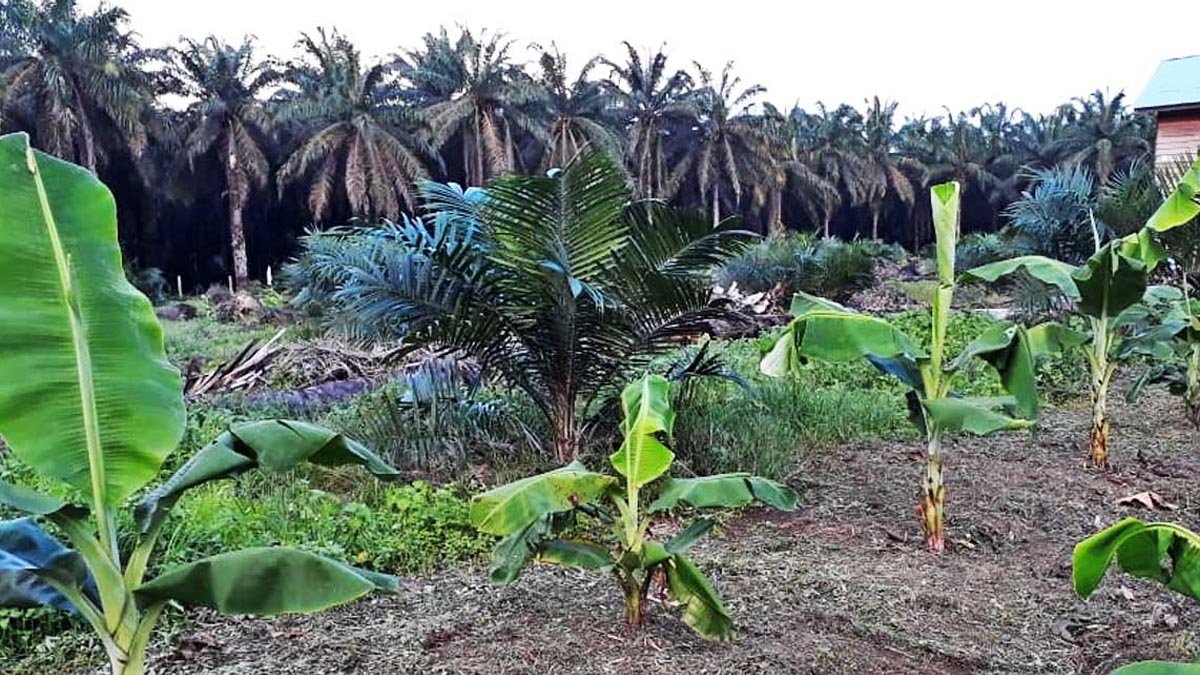
PALMOILMAGAZINE, MEDAN – Intercropping bananas within oil palm plantations remains a common practice among smallholders seeking additional income, particularly during the immature phase of oil palm development or when plantation productivity has yet to reach optimal levels. However, experts warn that the system must be carefully managed to avoid reducing palm oil yields.
Djan Muhayat, a practitioner at the Indonesian Oil Palm Research Institute (PPKS), said banana cultivation alongside oil palm is not necessarily problematic as long as plant populations remain under control and do not create excessive competition for sunlight, which is essential for oil palm growth.
Speaking in remarks quoted by Palmoilmagazine.com from PPKS on June 23, Djan explained that farmers may continue intercropping practices when economic conditions or land utilization considerations make them necessary. Nevertheless, such systems may result in lower fresh fruit bunch (FFB) production compared with plantations managed under optimal oil palm populations without additional shading.
According to him, the choice of banana variety plays a crucial role in determining the level of risk to oil palm plantations. Kepok bananas require greater attention because they produce numerous suckers that can spread rapidly and dominate growing space.
“If banana suckers are allowed to grow excessively, oil palms may lose access to sunlight, which is the main factor supporting photosynthesis and fruit production,” Djan said.
In contrast, varieties such as Barangan and Raja bananas are considered less problematic because they produce relatively fewer suckers and their growth generally declines after several fruiting cycles.
Also Read: FORTASBI Highlights Independent Smallholders’ Role in Emissions Reduction and Forest Conservation
Sunlight Remains Critical for Oil Palm Productivity
Djan emphasized that oil palm is a crop highly dependent on adequate sunlight. Therefore, dense intercropping systems can reduce long-term plantation productivity by limiting light penetration.
He cited examples showing that plantations with approximately 251 palms per hectare combined with intercropping systems may achieve maximum yields of around 25 tons per hectare. Under more optimal planting densities and better growing conditions, however, production can exceed 30 tons per hectare.
Wider spacing also allows palms to develop larger fruit bunches due to more uniform sunlight distribution throughout the plantation.
“The more sunlight the palms receive, the better the growth and bunch formation will be,” he explained.
Also Read: SPKS Urges Stronger BPDP Funding to Expand Palm Oil Certification and Boost Smallholder Productivity
Fertilizer Savings Offer Additional Benefits
Despite the potential impact on yields, lower planting densities and proper space management may offer economic benefits through improved fertilizer efficiency.
According to Djan, fertilizer requirements are directly linked to the number of plants maintained in the field. Fewer plants can reduce fertilization costs, making this an important consideration for farmers when deciding on plantation management strategies.
Also Read: Palm Oil as a Renewable Natural Resource
He therefore advised farmers who intend to practice intercropping to carefully select companion crops and regularly manage banana sucker populations, particularly for varieties known for vigorous propagation.
“Farmers may continue intercropping, but they should choose banana varieties that produce fewer suckers so that oil palm growth is not disturbed,” he concluded. (P2)