
PALMOILMAGAZINE, BOGOR – As global concerns over climate change and deforestation continue to intensify, Indonesia’s independent oil palm smallholders are increasingly being recognized as important contributors to low-emission development. Through regenerative agricultural practices and the protection of conservation areas, smallholders have demonstrated their capacity to reduce greenhouse gas emissions while maintaining environmental sustainability.
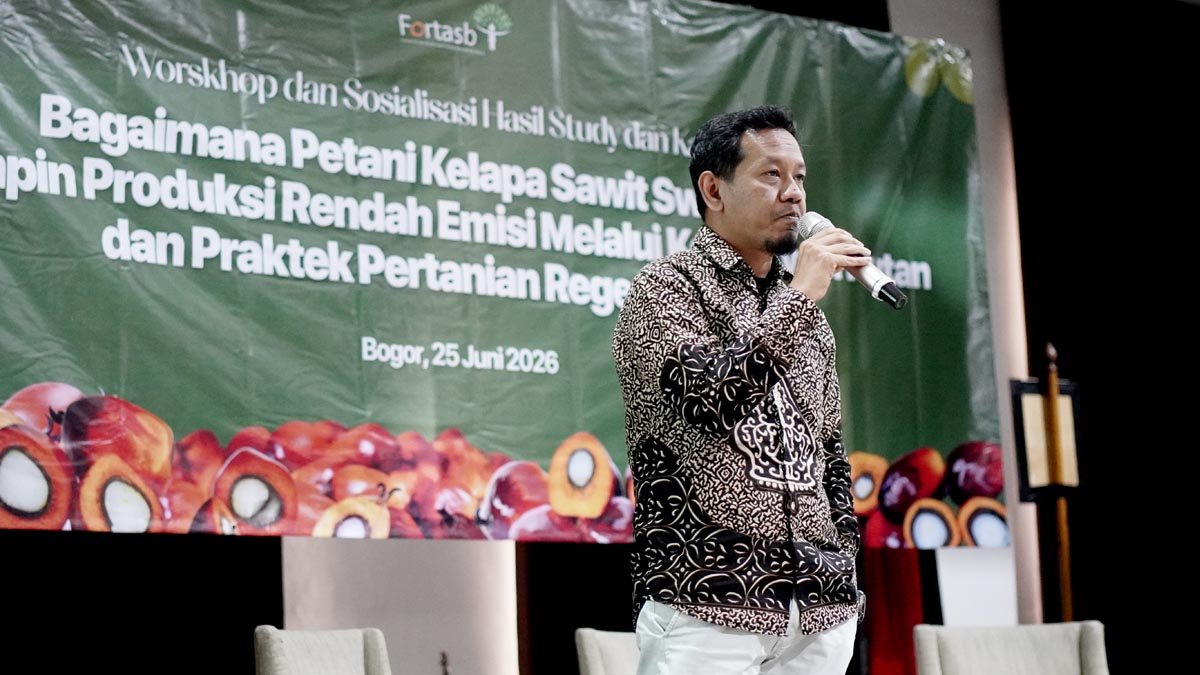
This message emerged during the workshop and dissemination event titled “How Independent Oil Palm Smallholders Lead Low-Emission Production through Forest Conservation and Regenerative Agricultural Practices,” organized by the Indonesian Sustainable Oil Palm Farmers Forum Foundation (FORTASBI) at Royal Padjadjaran Hotel in Bogor on Thursday (June 25, 2026), which was attended by Palmoilmagazine.com
As an organization representing certified sustainable oil palm smallholders, FORTASBI has introduced numerous conservation initiatives across Indonesia. Farmers in Jambi have undertaken riverbank rehabilitation programs, while smallholders in West Kalimantan have focused on protecting remaining forest areas surrounding their plantations.
Also Read: Building Climate-Resilient Farms: FORTASBI Guides Independent Smallholders Toward Low Emissions
In North Sumatra, Jambi, and Central Kalimantan, farmers have also begun implementing regenerative agricultural practices that emphasize soil health and long-term sustainability.
Between September 2025 and May 2026, FORTASBI collaborated with researchers and academics to assess the contribution of independent smallholders to carbon emission reductions through regenerative agriculture in North Sumatra. Another study evaluated biodiversity values and carbon stocks within community-managed conservation forests in West Kalimantan.
During the workshop’s first session, Gigit Pratama Ginarso, leader of the biodiversity assessment team in the customary forests managed by the Perkumpulan Petani Mitra Harapan (PPMH) in Manis Mata, Ketapang Regency, presented preliminary findings on biodiversity and carbon stock potential within these protected areas.
Also Read: Global Buyers Backing Smallholder Sustainability Earn FORTASBI Recognition at RSPO RT2025
Three community conservation forests in Manis Mata District—Brupis, Tamtam, and Air Dekakah—were found to serve as critical biodiversity refuges within landscapes dominated by smallholder oil palm plantations. Brupis covers approximately 48 hectares, Tamtam spans 21 hectares, and Air Dekakah extends across 37 hectares.
“These protected forests function as conservation cores within the smallholder oil palm landscape. Their existence is essential for preserving biodiversity, maintaining habitat connectivity, and supporting climate change mitigation efforts,” Gigit said.
The study identified numerous high conservation value species still inhabiting the forests, including pangolins, sun bears, tarsiers, deer, and protected plant species such as pitcher plants.
Also Read: Global Buyers Backing Smallholder Sustainability Earn FORTASBI Recognition at RSPO RT2025
According to Gigit, the continued presence of these species demonstrates that customary forests remain capable of performing important ecological functions despite increasing land-use changes and agricultural expansion.
In terms of habitat quality, Brupis recorded the highest ecological score at 39, indicating relatively intact ecosystem conditions. Tamtam received a score of 29, while Air Dekakah scored 24.
“Brupis remains in very good ecological condition, whereas Air Dekakah requires greater attention because of its high level of fragmentation and the need for restoration measures,” he explained.
Also Read: Indonesia Accelerates B50 Rollout as Cross-Sector Testing Advances Ahead of July Launch
Habitat connectivity was also identified as a key factor in maintaining wildlife populations. Tamtam showed the highest connectivity value, supporting animal movement between forest areas. By contrast, Air Dekakah was identified as the most fragmented landscape, highlighting the need for habitat restoration and ecological rehabilitation.
The three protected forests also play an important role in carbon sequestration. Researchers estimated total carbon stocks at 13,958 tons of carbon, equivalent to approximately 51,181 tons of carbon dioxide equivalent (tCO₂eq).
Gigit emphasized that these carbon reserves make a meaningful contribution to greenhouse gas mitigation efforts.
Also Read: KPBN CPO Prices Jump to IDR 15,575/kg on June 26 as B50 Policy Boosts Palm Oil Market Sentiment
“These areas are important not only for biodiversity conservation but also as carbon sinks that provide broader environmental benefits,” he said.
The study also identified several High Conservation Value (HCV) categories, including HCV 1, HCV 3, HCV 4, HCV 5, and HCV 6. The findings indicate that the landscapes possess significant ecological, environmental, social, and cultural values.
Based on the assessment, researchers recommended three management approaches. First, approximately 3,397 hectares should be prioritized for protection to safeguard conservation forests, natural habitats, and high conservation value areas.
Second, around 929 hectares were recommended for restoration activities aimed at rebuilding habitat corridors and improving landscape connectivity.
Third, environmentally responsible management practices should be implemented across 8,405 hectares through sustainable oil palm cultivation, river buffer protection, and increased vegetation cover.
Gigit stressed that collaboration among local communities, government agencies, and other stakeholders remains essential to ensuring long-term conservation success.
Also Read: Riau Independent Smallholder FFB Prices Rise by IDR 11.28/kg for June 24–30, 2026 Period
“Balanced landscape management that integrates conservation objectives with local economic activities is the key to preserving these protected forests while supporting the sustainability of smallholder oil palm plantations in the future,” he said.
The workshop also featured a presentation by Dr. Yanto Rochmayanto, who led a study titled “Assessing the Contribution of Independent Smallholders to Climate Change Mitigation through Regenerative Agriculture in North Sumatra.” The study found that regenerative farming practices can increase soil organic carbon levels and potentially reduce greenhouse gas emissions in smallholder oil palm plantations.
Additional speakers included Dr. Sri Mariati from the SDGs Hub at the University of Indonesia, Lisma Safitri, Ph.D. from INSTIPER Yogyakarta, Eko Budiono, Sustainability Manager at Cargill Kalimantan Region 3–4, and Dani Rahadian from SNV.
Also Read: Riau Plasma FFB Prices Slip Slightly for Late June Trading Period
The workshop was attended by representatives from palm oil companies, non-governmental organizations, academic institutions, research organizations, and independent oil palm farmers from various regions.
Their participation underscored the importance of multi-stakeholder collaboration in promoting low-emission palm oil production, protecting conservation areas, and strengthening the role of independent smallholders in sustainable development. (P3)