The Center for Law and Conflict Resolution says repossessed plantations transferred to state-owned Agrinas Palma Nusantara still require legal verification, land-rights clarification and safeguards for affected smallholders.
PALMOILMAGAZINE, JAKARTA — Repossession of plantations deemed problematic and the enforcement of forest-area regulations do not automatically resolve the underlying legal status of land, according to the Center for Law and Conflict Resolution (PURAKA).
The organization has warned of a number of risks facing smallholders after plantations reclaimed through the Forest Area Task Force (Satgas PKH) enter a management phase under state-owned Agrinas Palma Nusantara.
Also Read: BRIN and Sumitomo Develop 100% EFB Boiler Technology to Turn Palm Oil Residues Into Biomass Energy
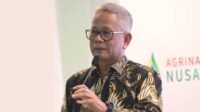
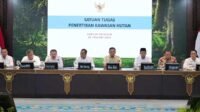
According to a presentation by PURAKA Head Ahmad Zazali on Thursday (Sept. 24, 2026), key issues following the repossession process include legal certainty, governance, protection of community rights, environmental safeguards and the sustainability of smallholders’ livelihoods.
PURAKA frames the issue around a central challenge: how to ensure that forest-area enforcement, state repossession of assets and subsequent management by Agrinas remain consistent with legal certainty, protection of community rights and environmental objectives.
The presentation outlined several stages in the process, beginning with plantations or forest areas identified as problematic, followed by repossession by Satgas PKH, transfer to Agrinas, management either independently or through cooperation agreements, resolution of forest-area status and, ultimately, settlement of land rights.
Also Read: Malaysia Palm Oil Exports Seen Stable at 16 Million Tons in 2027, MPOC Says
Repossession Does Not Automatically Resolve Land Status
One of PURAKA’s key points is that state repossession does not, by itself, settle the legal status of a forest area or the land rights associated with it.
Each stage, the organization noted, has its own legal basis, institutional authority, procedures and consequences. As a result, the process following repossession still requires clarity over both the status of the area and the underlying land rights.
Also Read: KPBN CPO Price Falls IDR515 to IDR15,000/kg as Malaysia Palm Oil Futures Drop 2.07%
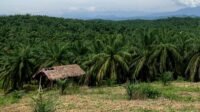
The issue becomes more complicated when repossessed plantations have previously been managed by local communities.
PURAKA identified several potential risks, including loss of livelihoods, legal uncertainty, agrarian disputes and uncertainty over the future management of plantations after they have been taken over by the state.
‘Illegal’ Status Requires Case-by-Case Verification
PURAKA also emphasized that plantations classified as problematic should be verified individually.
Such verification needs to consider the history of land occupation, permits, location, forest-area designation and the legal basis for land possession.
Also Read: Malaysia CPO Price Falls 2.07% to RM4,673, KPBN CPO Drops to IDR15,000/Kg
According to PURAKA, applying a uniform approach to all plantations could create further problems because the circumstances and history of land occupation may differ substantially from one location to another.
The presentation identified several types of smallholder plantations requiring different approaches to resolution.
These include farmers who were already living in villages before the designation of an area as forest; communities with claims to customary or ulayat land or those seeking recognition as customary law communities; farmers who entered forest areas after their designation; migrant farmers who acquired land through purchases; and plantations developed primarily to support household livelihoods.
Also Read: Riau Plasma FFB Price Falls to IDR 3,948.70/Kg for Sept. 23–29
PURAKA therefore outlined different potential resolution mechanisms, including facilitation through the Settlement of Forest Area Tenurial Issues (PPTKH) or Agrarian Reform Object Land (TORA) programs, recognition of customary law communities, social forestry or partnership arrangements, applications for forest-area release, and the development of sustainable alternative livelihoods.
Agrinas KSO Arrangements Also Require Transparency
Another issue raised by PURAKA concerns the potential management of repossessed plantations through cooperation agreements, or Kerja Sama Operasi (KSO).
The organization said such arrangements require transparency, clear partner-selection procedures and measures to mitigate potential conflicts of interest.
Also Read: Riau Palm Replanting Program Reaches 55,140 Hectares, Funding Tops IDR 1.9 Trillion
Under the mechanism outlined in the presentation, prospective partners may submit a letter of interest, followed by a selection process, feasibility assessment and approval involving relevant stakeholders before a cooperation agreement is implemented.
PURAKA also highlighted several potential challenges on the ground, including unclear plantation status and legality, overlapping control involving Satgas PKH, Agrinas and farmers, disputes with cooperatives, uncertainty surrounding KSO and partnership mechanisms, unclear distribution of economic benefits and the potential escalation of social conflicts.
For smallholders, legal certainty, transparent governance and protection of community rights will be critical in determining what happens to plantations after enforcement measures are completed.
Also Read: Indonesia’s B50 Biodiesel Push Puts Smallholder Access to CPO Supply Chain in Focus
PURAKA’s presentation called for a process that verifies plantation status, classifies plantations according to their respective characteristics, examines the history of land occupation and resolves outstanding legal issues before further management takes place.
The issue, therefore, extends beyond the repossession of assets. It also concerns whether the subsequent management process can avoid creating new uncertainty for local communities while remaining consistent with environmental protection objectives. (P2)