The Jakarta Corruption Court will begin hearing a case involving alleged manipulation of export classifications for CPO and its derivatives between 2022 and 2024, with investigators alleging that the scheme involved 15 companies and caused trillions of rupiah in state losses.
PALMOILMAGAZINE, JAKARTA — An alleged corruption case involving exports of crude palm oil (CPO) and its derivatives, which were allegedly disguised as palm oil mill effluent (POME) and other residual products, is set to enter the trial stage.
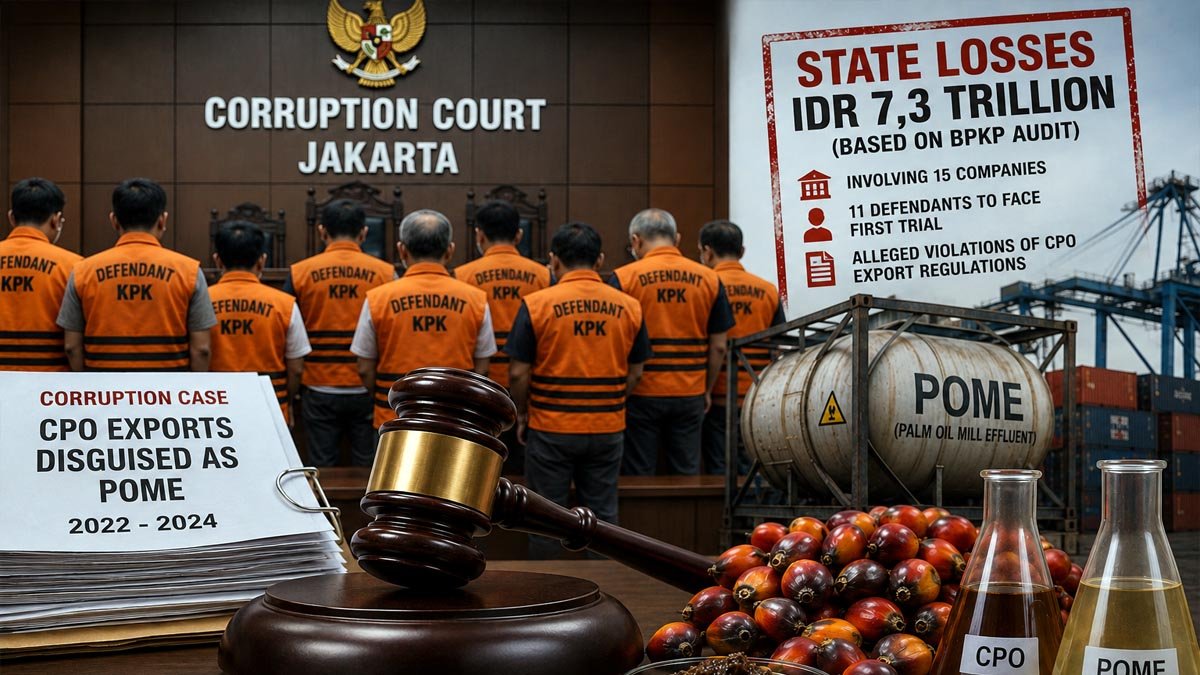
Eleven defendants are scheduled to appear for their first hearing at the Corruption Court of the Central Jakarta District Court on Tuesday (August 18, 2026). The hearing is expected to begin with prosecutors reading the indictments against all defendants in connection with alleged irregularities in CPO exports between 2022 and 2024.
Also Read: Ministry of Industry Backs Legal Probe, Suspends Official in Palm Oil and POME Export Case
According to information reported by ANTARA, Central Jakarta District Court spokesperson Andi Saputra said the 11 defendants were accused of involvement in actions that allegedly benefited themselves, other parties, or corporations.
The case involves 15 companies and, based on an audit by Indonesia’s Financial and Development Supervisory Agency (BPKP), allegedly resulted in state financial losses of approximately IDR 7.3 trillion.
“They are charged in a corruption case involving benefits obtained by themselves, other parties, or corporations, involving 15 companies, in connection with CPO exports that allegedly caused state losses of IDR 7.3 trillion,” Andi said.
Also Read: Alleged POME Fraud in Indonesia Raises Red Flags Across Global Biofuel Supply Chains
Government Officials and Corporate Executives Among Defendants
The 11 defendants include government officials and representatives of private companies.
Among the government officials is Fadjar Donny Tjahjadi, who served as Director of Customs Technical Affairs at the Directorate General of Customs and Excise under the Ministry of Finance from 2017 to 2024.
Another defendant is Lila Harsyah Bakhtiar, a senior policy analyst and industrial development official at the Ministry of Industry’s Directorate of Forest and Plantation Product Industries, who served from 2021 to 2024.
Also Read: Closing the Biomethane Loop: Why POME Must Become Part of Indonesia’s Energy Strategy
Also facing trial is Muhammad Zulfikar, who served as Head of Customs and Excise Services Section VI at the Dumai Customs and Excise Supervision and Service Office in 2021.
The corporate defendants include Edy Susanto, President Director of PT Sinar Mutiaranusa Palmindo; Tony, Director of PT Tanimas Edible Oil; and Yusrin Husin, Director and owner of PT Kencana Permata Nusantara.
The remaining defendants are Randy Tjahyadi Maliwarna, Director of PT Trimitra Agro Jaya; Van Ricardo, Director of PT Surya Inti Primakarya; Felix, Director and owner of PT Agrojaya Perdana; Erwin, Director of PT Bumi Mulia Makmur; and Robin, Director of PT Cakra Kaya Kreasi.
Also Read: ICAO Officially Approves POME as a Certified Feedstock for Sustainable Aviation Fuel
Alleged Manipulation of CPO Export Classification
The case is linked to government policies introduced between 2022 and 2024, when Indonesia tightened controls on CPO and palm oil derivative exports to safeguard domestic cooking oil supplies and contain price volatility.
Export controls included the Domestic Market Obligation (DMO), export approval requirements, export duties and palm oil export levies.
Under customs regulations, CPO is classified as a strategic commodity under HS Code 1511. The classification does not differentiate CPO based on its free fatty acid (FFA) content.
Also Read: Attorney General’s Office Probes Misuse of Palm Oil Mill Effluent (POME) Export Permits
As a result, high-acid CPO remains subject to the same CPO export control regime and related government obligations.
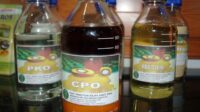
Investigators, however, suspect that the classification of certain export commodities was manipulated. Material described in the case as high-acid CPO was allegedly declared as POME or Palm Acid Oil (PAO) under HS Code 2306.
The alleged reclassification is suspected of having been used to circumvent export requirements applicable to CPO. Under the scheme alleged by investigators, commodities that were substantively CPO could be exported from Indonesia as if they were residual or waste products outside the CPO export control regime.
Also Read: Exports of POME Surpass CPO Volumes, Indonesia Enforces Stricter Export Regulations
Alleged State Losses Reach IDR 7.3 Trillion
Investigators allege that the irregularities were not merely administrative. The defendants are accused of knowing the applicable CPO export regulations and allegedly playing roles in designing, using or allowing the disputed classification mechanism to operate.
According to BPKP’s calculation of state financial losses, the case allegedly caused losses of around IDR 7.3 trillion.
Investigators have also seized assets allegedly connected to the case, including approximately IDR 40 billion in cash, as well as land, buildings, oil palm plantations and vehicles. The total value of the seized assets is estimated at around IDR 696.5 billion.
Also Read: When Smallholders Support Global Palm Oil Markets, It Is Time to Rethink Farm Scale
The opening hearing on Tuesday marks a key stage in the legal proceedings, with public prosecutors set to present the indictments that will form the basis of the court’s examination of the 11 defendants.
The defendants are charged under Article 603 in conjunction with Article 20 letters a or c of Indonesia’s new Criminal Code, or Article 3 in conjunction with Article 18 of Law No. 31 of 1999 on the Eradication of Corruption, as amended by Law No. 20 of 2001.
The trial will examine the alleged irregularities in the export activities, including how commodity classifications were used and the extent to which the defendants’ alleged actions were linked to the state financial losses calculated by BPKP. (P2)